Grinder · Manual hand grinder (espresso)
1Zpresso J-Max
1Zpresso · $$$
An espresso-focused hand grinder with fine micro-step adjustment.
Price range
$155 – $195
1Zpresso J-Max on video
Lance Hedrick covers the 1Zpresso J-Max in a 33-minute video. Watch the review below, then see the details and where to buy — all without leaving the page.
Lance Hedrick takes a hands-on look at the 1Zpresso J-Max. We link it for its specs walkthrough and real-world impressions — form your own view by watching.
We may earn a commission when you buy through links on this page, at no additional cost to you.
More videos
Why this matters
The 1Zpresso J-Max occupies a specific and demanding niche: it is an espresso-first hand grinder engineered for baristas who refuse to accept coarse adjustment resolution when dialing in a shot. Espresso is the most unforgiving brew method in specialty coffee — the 9-bar extraction window tolerates almost no imprecision, and many hand grinders, even well-regarded ones, offer step sizes too coarse to reliably move between a channeling shot and a balanced one. The J-Max, with its 48mm conical burr set and fine micro-step adjustment system, is 1Zpresso's answer to that problem within a compact metal body that travels far more easily than any electric espresso-capable grinder in its class. At $155–195 USD, it is a genuine investment in manual grinding, but it remains substantially more affordable than comparable-precision electric options. The J-Max is purpose-built for home espresso enthusiasts dialing in single-origin shots on a lever, semi-automatic, or Flair-style portable machine; for travelers who bring a compact espresso device and won't accept compromised grind quality on the road; and for upgraders from entry-level hand grinders who have found coarse adjustment steps frustrating when hunting for a precise dial-in.
At a glance
Best for
- Manual espresso
- Travel espresso
Look elsewhere if
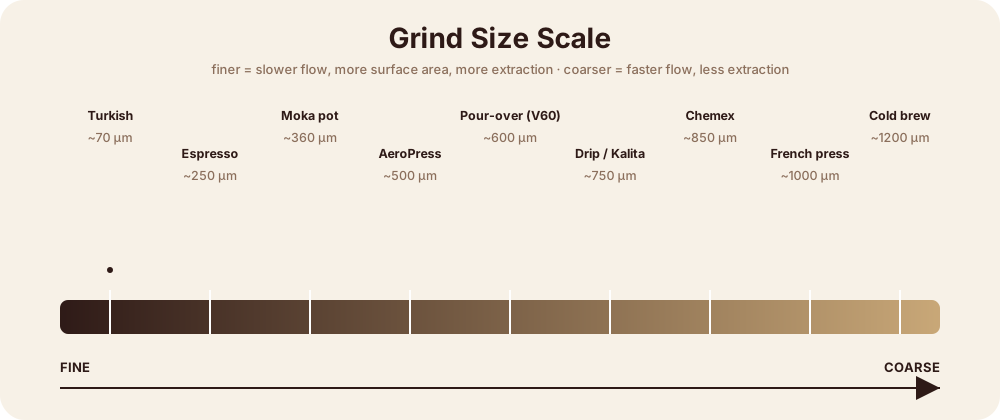
- You brew filter coffee as often as or more than espresso — the J-Max's burr geometry and adjustment range are optimized for espresso, and its coarse-end performance for pour-over, Chemex, or French press does not match dedicated filter-range grinders including 1Zpresso's own K-Series.
- You want a single grinder to cover multiple brew methods without compromise — the J-Max's espresso-leaning design makes it a poor multi-tasker compared to more versatile hand grinders at similar price points.
- The $155–195 USD price point is a stretch — meaningful espresso-capable hand grinders exist at lower price points, including the Timemore Chestnut series, and if budget is the primary constraint the J-Max's premium construction and fine-step system may not justify the extra spend for your use case.
- You expect electric-grinder speed and convenience — hand grinding a double-shot dose daily takes meaningful time and physical effort, and no design refinement in the J-Max changes that fundamental reality of manual grinding.
Closest alternatives
Featured in
**Build and Design**
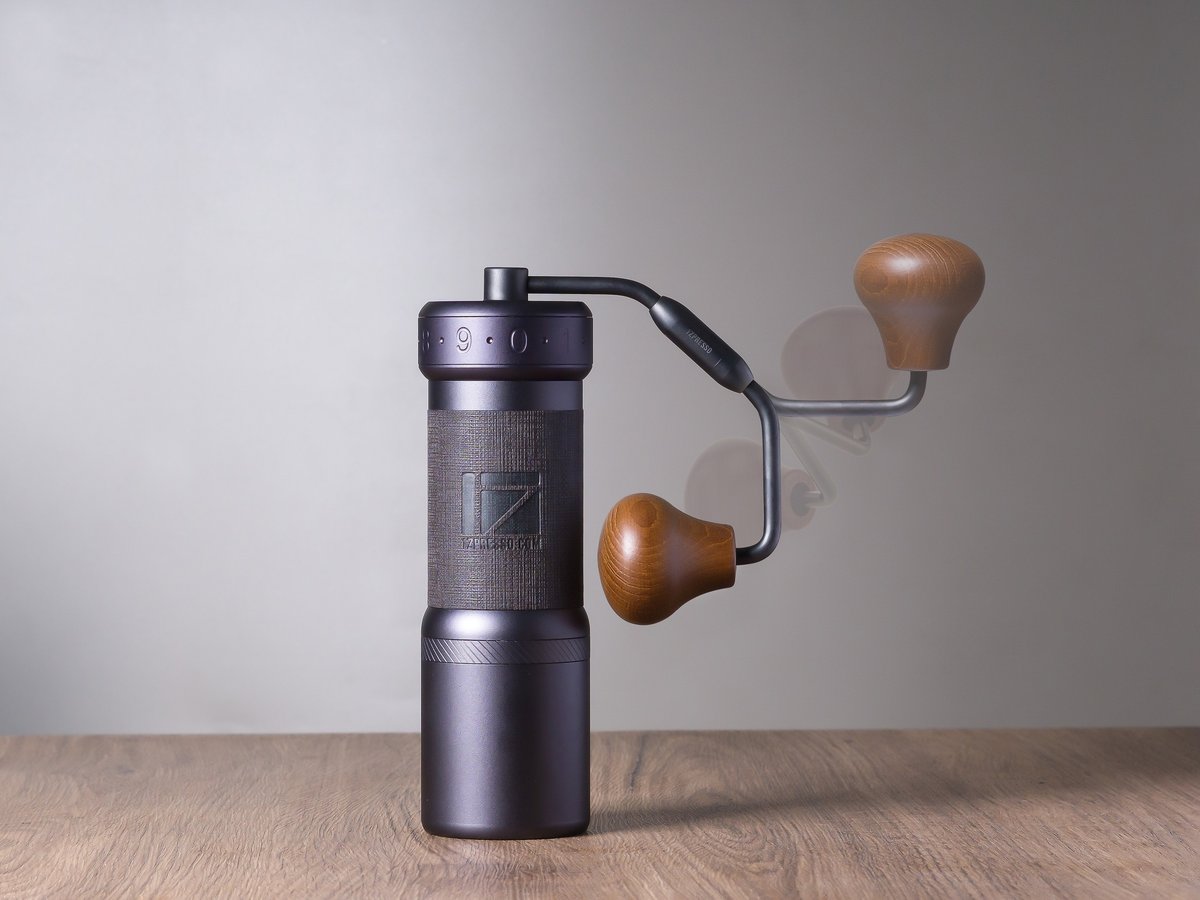
The 1Zpresso J-Max is constructed with a metal body throughout, giving it a solidity uncommon in hand grinders at this price point and virtually unheard of at lower tiers. The chassis follows 1Zpresso's established cylindrical form factor: a knurled grip section, a top-loading hopper, and a removable catch cup at the base. The all-metal construction contributes meaningfully to grind consistency — plastic bodies flex under torque, introducing subtle burr misalignment that manifests in wider particle distribution, while the J-Max's rigid frame keeps the burr stack geometry stable through each rotation.
The defining mechanical feature of the J-Max is its adjustment dial, which sits externally on the body and uses a numbered, indexed system. This external placement is a significant ergonomic advantage over grinders that require reaching under the hopper or disassembling components to change settings. Baristas can note their dial position for a given coffee and return to it with precision, which is essential for espresso workflow — particularly when switching between multiple single-origin coffees with different density and roast profiles that require different grind settings.
The 48mm conical burrs are the largest 1Zpresso deploys in the J-Series and represent a practical ceiling for what can be efficiently hand-cranked. Larger burrs demand more torque per rotation, creating a trade-off between burr surface area (which increases throughput and can improve particle uniformity) and the physical effort required per dose. At 48mm, the J-Max sits at the upper boundary of what most users can grind comfortably without fatiguing before a double-shot dose is complete. Grinding is noticeably faster than with 38mm or 40mm burr hand grinders, which is a material quality-of-life improvement for daily espresso use.
The micro-step adjustment system is the J-Max's most consequential specification. Fine espresso adjustment steps allow the user to make very small, repeatable grind-size changes between shots — the difference between a 25-second and a 29-second pull on a given coffee can be as little as one or two clicks on the J-Max. Grinders with coarser steps force baristas into larger adjustments, making it difficult to pinpoint optimal extraction without overshooting. For espresso work, this resolution is not a luxury; it is the functional specification that separates a grinder that can dial in from one that can only approximate.
**Performance**
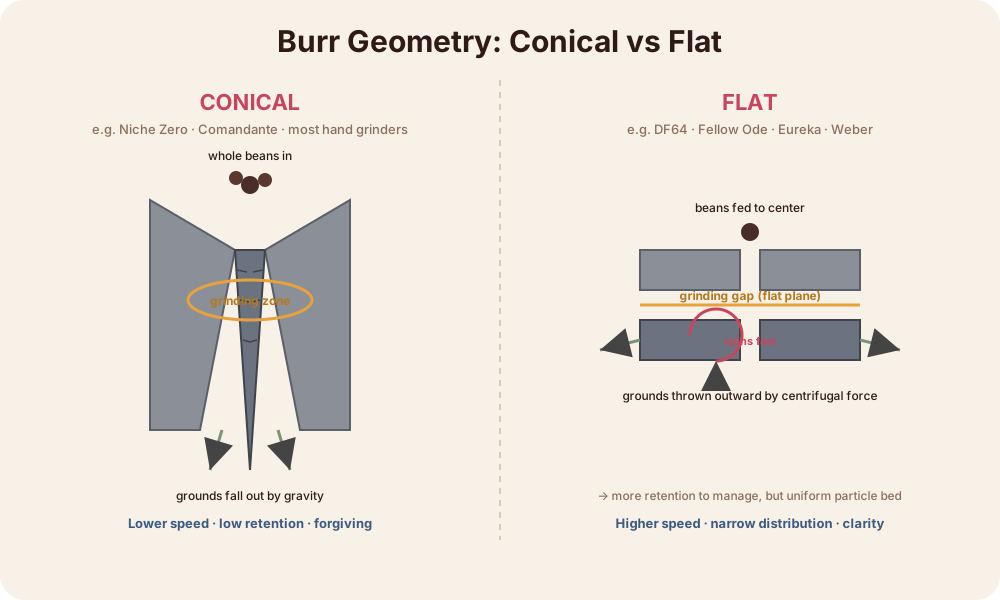
The J-Max's 48mm conical burr geometry produces a particle distribution well-suited to espresso: a prominent fine-particle peak that supports the dense, saturated extraction espresso requires, with a secondary coarse fraction that limits over-extraction. Conical burr designs characteristically produce a bimodal distribution, and 1Zpresso has tuned the J-Max's burr geometry specifically toward the espresso end of that spectrum, meaning the coarse tail is less pronounced than in grinders designed for dual-use across filter and espresso. This is a deliberate design trade-off — the J-Max excels at producing the rich, textured body and sweetness associated with well-extracted espresso, but its range toward coarser filter settings is limited compared to 1Zpresso's own K-Series or J-Ultra, which are designed with broader brew-method compatibility.
Retention in hand grinders is inherently low compared to electric grinders with long chute paths, and the J-Max follows this pattern — the grounds path from burr to catch cup is short, and very little coffee is stranded between sessions. This matters practically: zero-retention workflow means the first grounds out of the grinder reflect your current setting, not a blend of yesterday's and today's coffee. For single-dose espresso work, this is a significant advantage.
Grinding effort is moderate for a hand grinder producing espresso-fine output. The 48mm burrs reduce effort compared to smaller-diameter conicals at equivalent grind settings, and the J-Max's handle geometry allows torque to be applied efficiently. A 18–20g espresso dose can be ground in approximately one to two minutes at a steady pace for most users, though this varies with individual strength and the fineness of the target setting.
**Day-to-Day Workflow**
The J-Max is designed around a single-dose espresso workflow. The top-loading hopper accepts a weighed dose directly — 18–20g is comfortable — and the removable catch cup collects grounds cleanly. The numbered external dial allows settings to be recorded and recalled, which supports both consistency and the ability to maintain multiple recipes for different coffees. The compact dimensions make the J-Max easy to store, easy to pack for travel, and compatible with portable espresso devices including Flair, Cafelat Robot, and Aeropress-based espresso workflows.
Maintenance requirements are minimal by design. Conical burrs are less prone to clogging than flat burrs with oily or dark-roasted beans, and the J-Max disassembles for periodic cleaning without requiring specialized tools beyond what 1Zpresso includes. For regular use, a brush-out every one to two weeks and a full burr cleaning monthly is a reasonable maintenance cadence. The metal body resists the cosmetic wear — scratching, fading, stress-cracking — that limits the aesthetic longevity of plastic-bodied competitors.
For travel, the J-Max's metal body trades some weight versus plastic alternatives but delivers a grinder that withstands bag compression, temperature cycling, and the incidental impacts of travel without the structural risk that lighter materials present. Paired with a Flair 58 or similar travel-compatible espresso device, the J-Max constitutes a genuinely capable travel espresso setup rather than a compromise.
**Honest Trade-offs**
The J-Max's espresso-optimized burr geometry is also its primary limitation. Specialty coffee drinkers who brew espresso exclusively will find the J-Max's performance at its finest settings excellent, but those who want one hand grinder to serve both espresso and a morning pour-over or Chemex will find the J-Max frustrating. Its grind range at the coarser end is constrained compared to 1Zpresso's own K-Max or K-Ultra, and the particle distribution at coarse settings reflects burrs tuned for espresso — not the cleaner, more even distribution a dedicated filter grinder produces. If your workflow includes both espresso and filter brewing, the J-Max is the wrong tool.
The premium price of $155–195 USD is a genuine barrier. This is a segment of the market where the competition has grown sharper — the Timemore Chestnut S3 and similar options undercut the J-Max significantly, and while the J-Max's build quality and adjustment resolution justify its price to dedicated espresso users, the cost differential is real and meaningful.
There is also the broader question of hand grinding for espresso at all. The physical effort required to grind a double-shot dose daily — and the time investment versus an electric grinder — is simply incompatible with some users' mornings. The J-Max makes hand-grinding for espresso as convenient as it can be, but it cannot eliminate the inherent time cost of the process.
**Head-to-Head: J-Max vs. Named Peers**
*1Zpresso J-Max vs. 1Zpresso K-Max:* Within 1Zpresso's own lineup, the K-Max positions itself as a broader-range grinder with larger burrs, while the J-Max narrows its focus to espresso precision. Users who want to grind espresso and occasionally prepare filter coffee should lean toward the K-Max for its wider adjustment range. The J-Max is the correct choice only for those whose primary or exclusive use case is espresso.
*1Zpresso J-Max vs. Kinu M47 Phoenix:* The Kinu M47 Phoenix is the J-Max's most credible direct competitor in the premium manual espresso grinder space. The M47 Phoenix uses a 47mm conical burr set and offers stepless adjustment, which some baristas prefer over the J-Max's stepped system for its ability to make infinitely fine corrections. The M47 Phoenix is typically priced higher, and its all-stainless construction is heavier. The J-Max's numbered step system is arguably more repeatable day-to-day for users who record settings, while the M47's stepless system requires more tactile precision. Both are excellent; the choice comes down to preference for indexed versus stepless adjustment.
*1Zpresso J-Max vs. Comandante C40 MK4:* The Comandante C40 is a filter-coffee benchmark that has expanded its espresso capability through the optional Red Clix nitro blade upgrade. Without Red Clix, the C40's step size is too coarse for reliable espresso dial-in. With Red Clix, the C40 becomes espresso-capable, though its overall grind distribution is optimized for filter. The J-Max is the purpose-built espresso choice between the two; the C40 (with Red Clix) is the better filter grinder that can do espresso. At comparable price points, the decision should be driven by whether espresso or filter is the primary use case.
*1Zpresso J-Max vs. Timemore Chestnut S3:* The S3 is a serious challenger at a lower price point and offers good espresso performance. The J-Max's build quality, burr set, and adjustment resolution are generally rated higher by experienced users, and the price premium reflects a real performance difference at the finest espresso settings — particularly for single-origin, light-roast espresso where extraction precision matters most. For dark-roast espresso where the margin for error is wider, the cost differential is harder to justify.
The J-Max is not the right tool for every espresso drinker, but for those who have committed to manual espresso and want the best grind-quality-per-dollar ratio in a hand grinder, it is one of the most purpose-fit options available.
Pros
- Very fine espresso adjustment
- Fast 48mm burrs
- Compact for espresso travel
Cons
- Espresso-leaning range
- Premium price
Who reviewed it
We synthesized this page from independent reviews and the manufacturer's own materials. Conclusions below are paraphrased, not quoted.
Sprometheus
Rates the J-Max as one of the most dialed-in manual espresso grinders available, praising its fine adjustment resolution and consistent shot-to-shot repeatability as standout qualities in its price tier.
Lance Hedrick
Highlights the J-Max's 48mm burr set and external numbered dial as practical advantages for espresso workflow, noting that its espresso-focused range limits its versatility for filter brewing.
James Hoffmann
Acknowledges 1Zpresso's J-Series as a serious option for manual espresso enthusiasts, noting that the brand's engineering focus on fine adjustment resolution distinguishes it from more general-purpose hand grinders.
Prima Coffee
Recommends the J-Max to committed home espresso brewers willing to invest in a hand grinder optimized specifically for the tight grind window espresso demands, while flagging the limited filter-brew range as a genuine trade-off.
European Coffee Trip
Notes the J-Max's premium build quality and compact dimensions make it one of the more credible travel espresso grinders at its price point, suitable for pairing with portable espresso devices.
Whole Latte Love
Positions the J-Max as a top-tier manual espresso grinder, emphasizing the fine micro-step system and the metal body's durability as key differentiators from lighter-built competitors.
Frequently asked questions
What size burrs does the 1Zpresso J-Max use?
The J-Max uses 48mm conical burrs, which is the largest burr size in 1Zpresso's J-Series and provides faster grinding and higher throughput compared to smaller-diameter hand grinder burrs.
Is the J-Max suitable for pour-over or filter coffee?
The J-Max is primarily engineered for espresso. Its burr geometry and adjustment range are optimized for fine espresso settings, and its performance at coarser grind settings for filter brewing methods like pour-over or French press is limited compared to grinders designed for broader brew-method compatibility, such as 1Zpresso's K-Series.
How does the grind adjustment system work on the J-Max?
The J-Max uses an externally accessible numbered dial with fine micro-step increments. The numbered system allows baristas to record specific dial positions for different coffees and return to them reliably, which is particularly useful for espresso where small grind changes have significant impact on extraction.
What is the price range for the 1Zpresso J-Max?
The J-Max is priced between approximately $155 and $195 USD, placing it in the premium tier for manual hand grinders. 1Zpresso offers free worldwide shipping on grinders directly through their website.
How does the J-Max compare to the 1Zpresso K-Max?
The K-Max is designed for broader brew-method compatibility with a wider adjustment range, making it the better choice for users who want one grinder for both espresso and filter coffee. The J-Max narrows its focus to espresso precision, offering finer adjustment steps optimized for the tight grind window espresso requires. If espresso is your exclusive or primary use case, the J-Max is the purpose-fit choice; for versatility, the K-Max is more appropriate.
How does the J-Max compare to the Kinu M47 Phoenix?
Both are premium manual espresso grinders with similar burr sizes. The Kinu M47 Phoenix uses stepless adjustment, which allows infinite fine-tuning but requires tactile precision to reproduce settings. The J-Max's numbered step system is more straightforwardly repeatable for day-to-day use. The M47 Phoenix is typically priced higher. Both are high-performing options; preference for indexed versus stepless adjustment is often the deciding factor.
Is the J-Max good for travel?
Yes — the J-Max's compact metal body and all-metal construction make it well-suited for travel. It pairs naturally with portable espresso devices such as the Flair, Cafelat Robot, and Aeropress-based espresso setups. The metal chassis withstands the physical demands of bag packing and transit better than plastic-bodied alternatives.
How much effort does it take to grind a shot's worth of coffee with the J-Max?
The 48mm burrs reduce grinding effort compared to smaller-diameter conical burrs at equivalent espresso-fine settings. Most users can grind an 18–20g espresso dose in roughly one to two minutes at a comfortable pace. Grinding effort is moderate — less than smaller-burr hand grinders but still a meaningful physical task compared to electric grinders.
How much coffee does the J-Max retain between grinds?
Like most hand grinders, the J-Max has very low grind retention due to the short grounds path from burr to catch cup. This means the grounds exiting the grinder immediately reflect the current setting, making it well-suited for single-dose espresso workflows where retention would otherwise dilute freshness or grind-size precision.
How do I maintain the J-Max?
Routine maintenance involves brushing out the burr chamber and catch cup after each use, with a more thorough burr cleaning every few weeks depending on use frequency. The J-Max disassembles without specialized tools. Conical burrs are generally less prone to clogging from oily or dark-roasted beans than flat burrs, reducing maintenance frequency for typical espresso use.
What is 1Zpresso's return policy for the J-Max?
According to 1Zpresso, orders cancelled before shipping receive a full refund including shipping. Items returned in original condition within 7 calendar days of receipt receive a refund of the item's price. Returns made after 7 calendar days receive 80% of the item's price. Any customs duties or additional charges are deducted from refunds.
Who is the J-Max best suited for?
The J-Max is best suited for home baristas who brew espresso as their primary or exclusive method and want maximum dial-in precision from a hand grinder; for travelers who pair a portable espresso device with a carry-friendly grinder; and for enthusiasts upgrading from hand grinders with coarser adjustment steps who have found imprecise step sizes frustrating when chasing consistent espresso extraction.
Compare with
More grinders
Baratza
Baratza Sette 270Wi
A fast, low-retention espresso grinder with built-in grind-by-weight dosing.
Niche
Niche Zero
The single-dose grinder that popularised low-retention conical grinding for home espresso.
1Zpresso
1Zpresso K-Ultra
A fast, versatile 48mm hand grinder with an intuitive external adjustment dial.
Eureka
Eureka Mignon Specialita
A quiet, reliable 55mm flat-burr espresso grinder and longtime prosumer staple.
We may earn a commission when you buy through links on this page, at no additional cost to you.
Last updated: June 13, 2026