Brewer · Immersion / pressure (travel)
AeroPress Go
AeroPress · $
A travel-oriented AeroPress that packs into its own mug.
Price range
$35 – $55
AeroPress Go on video
James Hoffmann covers the AeroPress Go in a 15-minute video. Watch the review below, then see the details and where to buy — all without leaving the page.
James Hoffmann takes a hands-on look at the AeroPress Go. We link it for its specs walkthrough and real-world impressions — form your own view by watching.
We may earn a commission when you buy through links on this page, at no additional cost to you.
More videos
Why this matters
The AeroPress Go occupies a specific and well-defined niche: it is the travel-first iteration of one of the most influential manual brewers in specialty coffee, designed to pack completely inside its own drinking vessel so that the entire kit ships as a single, compact unit. Since Alan Adler introduced the original AeroPress in 2005, the brewer has built a cult following among travelers, backpackers, and office workers who refuse to surrender cup quality to convenience. The Go, launched to address the one legitimate complaint about the original — that it required a separate cup — closes that loop. It brews using the same patented three-in-one immersion-plus-light-pressure principle (steep like a French press, filter like a pour-over, press with air pressure) that earned the original its reputation. Priced between $35 and $55, it sits at an accessible entry point for specialty coffee gear. It matters most to people who move constantly — frequent flyers, campers, hostel-hoppers, commuters — and who want a complete, self-contained coffee system that fits in a daypack without a dedicated vessel taking up additional space. It is less transformative for home brewers, who will find the original or the XL a better value.
At a glance
Best for
- Travel
- Camping
- Office
Look elsewhere if
- You brew for more than one person at a time, or prefer a large 300 ml+ mug — the Go's roughly 237 ml maximum capacity per press will require multiple rounds.
- You already carry a reusable cup on every trip — the original AeroPress achieves identical brew quality at a lower price and smaller packing profile without the redundant travel mug.
- You want genuine espresso-range pressure with real crema — the Go produces approximately 0.35 bar, not the 9 bar required for true espresso; consider a Wacaco Nanopresso for pressure-sensitive recipes.
- You brew primarily at home and don't travel — the original AeroPress or the XL offer better value without the travel-mug bulk premium.
Closest alternatives
Featured in
The AeroPress Go is a travel-specific manual coffee brewer that combines immersion steeping with light manual pressure to produce a clean, low-bitterness cup. It is made from BPA-free plastic and is designed so that the plunger, brew chamber, filter cap, stir stick, scoop, and micro-filters all pack inside the travel mug that also serves as the brew vessel's base during use. The complete kit measures small enough to drop into a jacket pocket or the top compartment of a travel bag, which distinguishes it from the bare original AeroPress, which ships without any cup.
**Build and Design**
The materials are BPA-free, copolyester-based plastic throughout — lightweight, shatterproof, and resistant to the temperature extremes typical of outdoor use. The brew chamber and plunger are the same basic geometry as the original AeroPress but sized to fit inside the travel mug, which has a lid. The mug itself doubles as the drip stand during brewing: you place the mug on a stable surface, seat the inverted or standard-orientation brew chamber on top of it, and press down. The lid of the mug seals tightly enough to be leak-resistant during transport after brewing is complete. The full kit weighs very little — under 300 grams complete — and the stacked diameter is narrow enough to fit in most standard water-bottle pockets on backpacks.
The filter cap accepts both the standard AeroPress paper micro-filters (350 per pack, available from AeroPress and third parties) and the aftermarket metal filters from brands such as Able Brewing, which produce a heavier-bodied cup by allowing more oils through. This filter ecosystem compatibility is one of the Go's genuine strengths: the entire universe of standard-size AeroPress accessories — flow control caps, reusable metal filters, prism filters — is compatible, since the Go uses the same 63 mm filter diameter as the original.
**Brewing Performance**
The brewing mechanism is identical in principle to the original AeroPress. Coffee grounds and hot water are combined in the brew chamber for a user-defined steep time, and then the plunger is pressed down, forcing the brew through the micro-filter and into the cup below. The practical brew yield with the Go is slightly smaller than the original: the brew chamber accommodates roughly 237 ml (8 oz) compared to the original's capacity for up to approximately 296 ml (10 oz) in a single press, and the travel mug has a stated capacity of approximately 237 ml. For single-serve brewing, this is sufficient. For anyone who regularly brews two cups or wants to produce a larger concentrate to dilute with water in the style of an Americano, the smaller chamber is a tangible limitation.
Brew temperature is user-controlled entirely by the water you pour in, which means results vary based on your kettle or hotel-room hot tap. Specialty coffee convention suggests water between 80°C and 96°C (176°F–205°F) depending on the coffee's roast level and the recipe, and the Go's plastic chamber retains heat adequately for a 60–90 second steep. There is no built-in temperature regulation. A standard dose runs between 15 g and 18 g of ground coffee with roughly 200–220 ml of water, though the AeroPress recipe community (formalized in part through the annual World AeroPress Championship) has produced hundreds of documented variations ranging from espresso-style concentrates using 20+ grams and minimal water to long cold-brew-adjacent recipes.
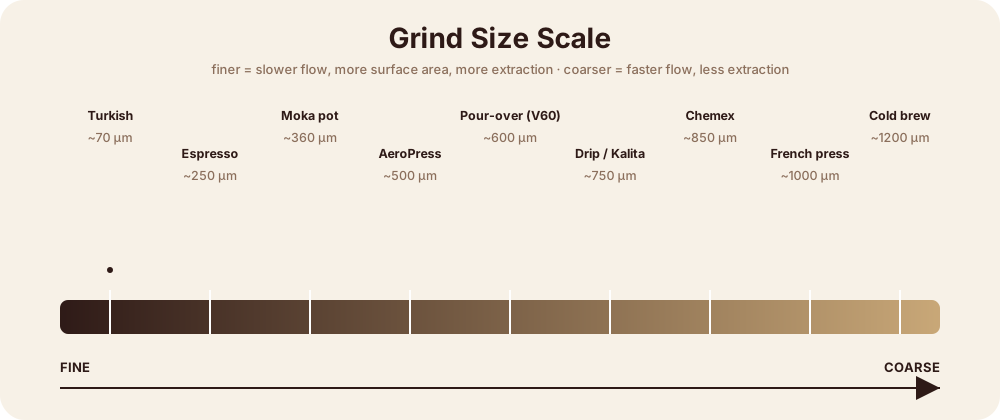
Grind size flexibility is a defining feature of the platform: the Go brews acceptably across medium-coarse, medium, medium-fine, and even fine grinds, with the filter preventing most fines from passing into the cup regardless of grind setting. This makes it highly forgiving when using whatever grinder is available on the road.
**Day-to-Day Workflow**
The standard brewing sequence takes approximately one to two minutes from water contact to finished cup. The cleanup routine is faster than nearly any other manual brewer: after pressing, a single push of the plunger ejects the spent puck and paper filter together into a bin, and a brief rinse under tap water leaves the chamber ready for reuse. There is no mesh to unclog, no carafe to scrub, and no basket to disassemble. This matters on the road, where access to cleaning facilities is inconsistent. Paper filters are compostable and light enough to carry a stack of 50 in a small zip-lock bag without meaningful weight cost. The travel mug lid prevents spills after brewing, which is relevant on trains and in cars where a bare cup would be a liability.
The one friction point in daily travel use is that the travel mug is, in absolute terms, slightly bulkier than carrying the original AeroPress alone without any cup. If you are traveling with a reusable cup you already own, the Go's integrated mug is redundant bulk. The original AeroPress, which retails closer to $39–$40, would then serve the same brewing function at a lower price and a smaller packing footprint.
The AeroPress Go is a genuinely well-executed piece of travel gear, but it requires honest framing: it does not brew differently from the original AeroPress in any meaningful way, and the decision to buy it over the original comes down almost entirely to whether you need the integrated travel mug. If you do, the Go is the most self-contained manual specialty brewer at its price. If you don't, the original saves you money and reduces pack volume.
**Versus the Original AeroPress**
The original AeroPress ($39–$40) uses the same BPA-free plastic construction, the same filter ecosystem, and the same three-in-one brew method. Its brew chamber accommodates slightly more volume per press and it is marginally lighter and narrower without a mug attached. For a traveler who already carries a reusable cup, the original is the rational choice. The Go's value proposition is specifically for travelers who do not want to carry a separate vessel — hostel stays, ultralight packing, air travel where every item in a bag needs to justify itself.
**Versus the AeroPress XL**
The XL is a larger-format version of the original with a correspondingly higher capacity, intended for multi-cup brewing or for people who brew one large mug at a time. It does not pack into a mug and is explicitly not a travel-optimized product. At a higher price and larger footprint, the XL competes with the Go only on the home shelf, where the Go has no particular advantage.
**Versus the Wacaco Nanopresso / Minipresso**
Travelers interested in true espresso-range pressure should note that the AeroPress Go, like all AeroPress brewers, operates at low manual pressure — approximately 0.35 bar, well below the 9 bar of a commercial espresso machine. It produces a concentrate that mimics some espresso characteristics but is not espresso in the technical sense. The Wacaco Nanopresso, by contrast, generates closer to 18 bar through a pump mechanism and produces a result with actual crema. The trade-off is that Nanopresso requires more technique, is more sensitive to grind precision, and has a narrower recipe range. The Go is more versatile and more forgiving across different coffee styles.
**Versus the Fellow Prismo Attachment**
For users who own the original AeroPress and want to approximate espresso-style pressure with back-pressure resistance, the Fellow Prismo ($30) is an aftermarket filter cap that creates a no-drip seal and allows pressure to build before the plunger releases the brew. It does not turn the original AeroPress into the Go, but it does make the original a more capable espresso-style tool for home use. The Go accepts the Prismo (Fellow confirms standard AeroPress filter cap compatibility), so this accessory path remains open.
**Honest Trade-offs**
The reduced brew volume is the most practically meaningful limitation. At roughly 237 ml maximum per press, the Go produces a single moderate-size cup. Users who brew for two people, or who prefer a larger 300 ml+ mug of coffee, will hit the ceiling immediately. The original's slightly larger chamber, or the XL for home use, addresses this. The travel mug is functional but not premium: it keeps coffee warm for a reasonable duration but is not vacuum-insulated, so heat retention over more than 20–30 minutes is limited. Travelers expecting thermos-level temperature retention will want to pair the Go's brew output with a separate insulated vessel.
The 1-year warranty from AeroPress covers manufacturing defects, and the plastic construction has a long track record of durability under travel conditions — drops on tent floors, stuffing into overpacked bags — without cracking. Replacement parts, including plunger seals (which flatten and lose efficiency after approximately 18–24 months of daily use) and filter caps, are available directly from AeroPress and through third-party retailers, which matters for long-term ownership. The seal is the single wear component; replacing it costs only a few dollars and immediately restores full function.
Pros
- Ultra-portable travel design
- Same brewing principle as Original
- Self-contained kit
Cons
- Slightly smaller capacity
- Travel mug adds bulk vs bare Original
Who reviewed it
We synthesized this page from independent reviews and the manufacturer's own materials. Conclusions below are paraphrased, not quoted.
AeroPress Official
AeroPress positions the Go as a complete three-in-one travel coffee system that packs into its own mug, emphasizing the same patented brew technology as the original at a price point of $49.95.
Source ↗James Hoffmann
Hoffmann has generally praised the AeroPress platform's versatility and forgiving brew physics, noting that the travel format makes sense for those who need a self-contained kit without sacrificing the brew method's core strengths.
Prima Coffee
Prima Coffee has highlighted the Go's self-contained design as its primary differentiator from the original, noting that the integrated mug justifies the modest price premium for travelers who value packing simplicity over marginal volume gains.
Wirecutter (New York Times)
Wirecutter has consistently recommended the AeroPress family as a top pick for manual brewing, with the Go specifically called out as the best option for travelers who want to avoid carrying a separate cup.
Whole Latte Love
Whole Latte Love has described the Go as a practical solution for on-the-go brewing, noting that its compatibility with the full range of standard AeroPress accessories extends its usefulness beyond the base kit.
CoffeeGeek
CoffeeGeek reviewers have noted that the Go's brew output is indistinguishable from the original when using the same recipe, making the purchase decision almost entirely about the integrated travel mug rather than any performance difference.
Frequently asked questions
What is the brew capacity of the AeroPress Go?
The AeroPress Go's brew chamber holds enough for approximately 237 ml (8 oz) of finished coffee per press, which matches the capacity of the included travel mug. This is slightly less than the original AeroPress, which can produce closer to 296 ml per press.
Does the AeroPress Go brew differently from the original AeroPress?
No. The Go uses the exact same three-in-one immersion-plus-light-pressure brew method as the original. The only functional difference is the smaller maximum capacity and the fact that it packs into an integrated travel mug.
Is the AeroPress Go compatible with standard AeroPress accessories?
Yes. The Go uses the same 63 mm filter cap diameter as the original AeroPress, meaning aftermarket metal filters (such as Able Brewing's Disk filter), the Fellow Prismo pressure cap, flow control caps, and standard paper micro-filters are all compatible.
What filters does the AeroPress Go use?
It uses the same circular AeroPress paper micro-filters (sold in packs of 350) as the original. Reusable stainless steel and fine-mesh aftermarket filters also fit, and produce a slightly fuller-bodied cup by allowing more coffee oils through.
How long does an AeroPress Go brew take?
A standard brew from water contact to finished cup takes approximately one to two minutes, including a 60–90 second steep. Cleanup — ejecting the puck and rinsing the chamber — adds about 20–30 seconds.
What water temperature should I use with the AeroPress Go?
Specialty coffee practice generally calls for water between 80°C and 96°C (176°F–205°F), with lighter roasts typically benefiting from higher temperatures and darker roasts from lower temperatures. The Go has no built-in temperature control, so this is entirely determined by how you prepare your hot water.
How durable is the AeroPress Go for travel and outdoor use?
The BPA-free plastic construction is shatterproof and resistant to drops, which makes it well-suited to outdoor use. The plunger seal is the primary wear component, typically lasting 18–24 months of daily use before noticeably flattening; replacement seals are available directly from AeroPress at low cost.
Does the travel mug keep coffee hot for a long time?
The travel mug is functional but not vacuum-insulated, so it will keep coffee warm for around 20–30 minutes under typical conditions. For longer heat retention, transferring the brew to a separate insulated thermos is advisable.
What is the price of the AeroPress Go and is it worth the premium over the original?
The Go retails between $35 and $55 USD, compared to approximately $39–$40 for the original AeroPress. The premium is justified only if you genuinely need the integrated travel mug; if you already carry a reusable cup, the original delivers identical brew quality at a lower price.
Can the AeroPress Go make espresso?
Not in the technical sense. The Go generates approximately 0.35 bar of manual pressure, far below the 9 bar required for true espresso. It can produce a concentrated brew that resembles espresso in some characteristics, suitable for use in milk-based drinks, but it will not have the same crema or extraction profile as a machine-pulled shot.
What grind size works best with the AeroPress Go?
The Go is highly tolerant of different grind sizes. A medium-fine grind is the most commonly recommended starting point, but the platform performs well across medium-coarse through fine, depending on steep time and recipe. Fines are largely caught by the paper micro-filter, reducing the penalty for imprecise grinding on the road.
What warranty does the AeroPress Go carry?
AeroPress provides a 1-year warranty covering manufacturing defects on all its brewers, including the Go.
Compare with
More brewers
Chemex
Chemex 6-Cup
The iconic hourglass carafe whose thick filters yield an exceptionally clean cup.
AeroPress
AeroPress Original
A versatile, near-indestructible immersion-and-pressure brewer with a global championship.
Kalita
Kalita Wave 185
A flat-bottom, three-hole dripper prized for forgiving, repeatable extractions.
Hario
Hario Switch
A V60-shaped dripper with a valve that combines immersion and percolation.
We may earn a commission when you buy through links on this page, at no additional cost to you.
Last updated: June 13, 2026