Grinder · Electric flat-burr (high-end)
Weber Workshops Key
Weber Workshops · $$$$
A high-end 83mm flat-burr single-dose grinder from a boutique manufacturer.
Price range
$650 – $850
Weber Workshops Key on video
James Hoffmann covers the Weber Workshops Key in a 26-minute video. Watch the review below, then see the details and where to buy — all without leaving the page.
James Hoffmann takes a hands-on look at the Weber Workshops Key. We link it for its specs walkthrough and real-world impressions — form your own view by watching.
We may earn a commission when you buy through links on this page, at no additional cost to you.
More videos
Why this matters
The Weber Workshops Key arrived on the specialty-coffee scene by winning Best New Product at the 2021 SCAA Expo — a signal that the boutique Portland manufacturer had produced something the industry considered genuinely significant rather than merely expensive. At its core, the Key is an 83mm flat-burr single-dose electric grinder: a format that, when the original model launched, was largely the domain of commercial machines costing several times more. Weber Workshops brought that burr diameter into a home-scaled chassis and paired it with the low-retention single-dose workflow that serious espresso enthusiasts demand, eliminating the stale-coffee problem inherent in hopper-fed designs. The Key sits as the more accessible entry point into Weber Workshops' grinder lineup — below the $4,000 EG-1 — and is designed for home baristas and small-café operators who want flat-burr character (clarity, separation, density) in both espresso and filter applications without committing to a full commercial footprint. It is expressly not a product for the casual drinker; it is a tool for those who have already refined their technique and want equipment that will not be the limiting factor in the cup.
At a glance
Best for
- High-end espresso
- Enthusiasts
Look elsewhere if
- The $2,050 asking price is genuinely difficult to justify if your espresso machine is under $1,000 — the grinder would be the most expensive component in the setup and its capabilities would be underutilized by a less precise extraction environment.
- Single-dose workflows require weighing every dose before grinding; if you want to fill a hopper and grind on demand throughout the day without a scale ritual, the Key's architecture actively works against you.
- Users whose primary brewing method is batch filter or pour-over, rather than espresso, will find the Key's flat-burr character optimized for a use case that isn't their primary one — a dedicated filter grinder with a conical burr set may serve that workflow better at lower cost.
- If your ceiling for a grinder is under $1,000 and you want flat-burr performance, the Lagom P64 occupies that space more practically; the jump from ~$750 to $2,050 is substantial and the improvement, while real, is incremental rather than transformative.
Featured in
**Build and Design**
The Weber Workshops Key Mk.2 is constructed throughout in premium metal — there is no plastic on the exterior of the grinder body, a deliberate design statement that separates it from the majority of even high-end consumer grinders. It ships in two colorways, Snow and Onyx, both executed with the kind of surface finishing that reads as jewelry-grade rather than appliance-grade. The Mk.2 designation means this is an iterative refinement of the SCAA award-winning original, with Weber Workshops applying the same engineering-first ethos that runs through the rest of their product catalog — which includes the EG-1, HG-2, and the manual BIRD brewer.
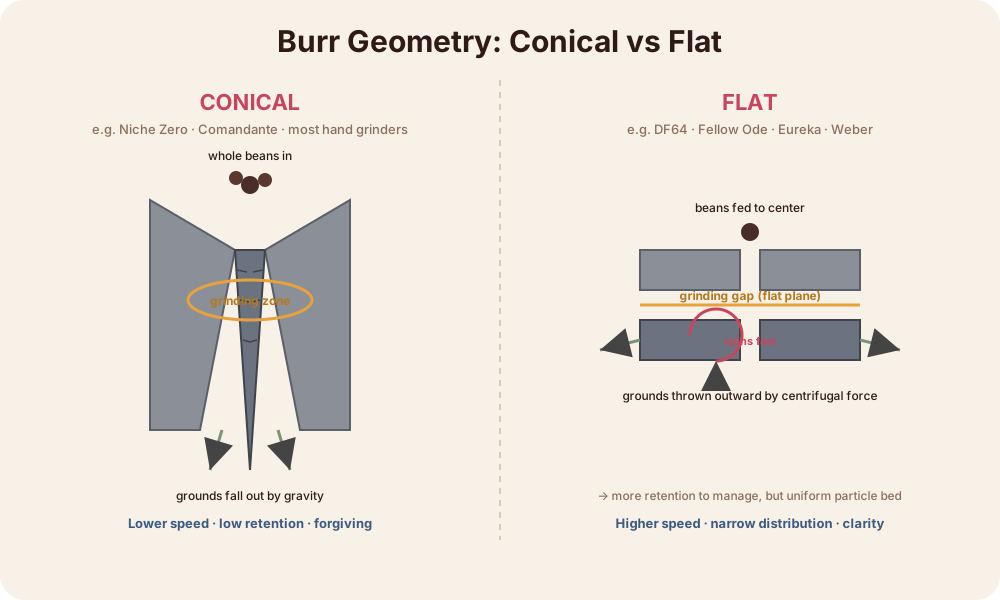
At 83mm, the Key's flat burrs are substantially larger than the 64mm flat burrs that populate the competitive set at lower price points (Fellow Ode Gen 2, Baratza Vario+, and similar machines). Burr diameter matters for two distinct reasons: surface area and rotational speed. Larger burrs can grind the same dose at lower RPM than smaller burrs while maintaining throughput, which reduces heat transfer to the grounds — a critical variable for both espresso extraction consistency and the preservation of aromatics in filter applications. An 83mm burr set also provides more cutting surface, which translates to a more uniform particle-size distribution across the grind range when the geometry and alignment are well-executed, as they are here.
The single-dose architecture means the Key has no traditional retention hopper. Each session begins with a weighed dose dropped directly into the feed throat; grounds exit into a portafilter, a dosing cup, or a filter basket placed directly beneath the chute. Low-retention design is not simply a marketing claim in the Key's case — it is the structural premise of the entire product. The grind path is engineered to minimize the dead volume where stale grounds accumulate between sessions. For home espresso users pulling one to three shots daily, this means the dose you weigh in is, within a fraction of a gram, the dose you grind out; there is no need to purge stale grounds before each shot, which is both wasteful and inconsistent.
The premium metal body contributes meaningfully to thermal mass. A heavier chassis absorbs and distributes heat more evenly during back-to-back grinding sessions, keeping burr temperature more stable than lightweight polymer-bodied competitors. Over the course of a multi-shot home tasting session — six to ten espresso pulls, for instance — this stability becomes practically relevant as extraction times and taste profiles remain more consistent from shot to shot.
**Performance and Grind Range**
The Key is positioned as a dual-use grinder covering espresso through filter, which is a demanding range for any flat-burr design. Flat burrs as a category produce a particle-size distribution that is bimodal relative to conical burrs — generally more fines alongside a dominant coarser fraction — which contributes to the dense, syrupy body and clarity of flavor separation that espresso enthusiasts associate with flat-burr machines. At filter settings, this same distribution produces a clean, defined cup with good sweetness separation, though some users find the fines content at coarser settings slightly elevated compared to a dedicated filter-optimized conical burr grinder.
Within the Weber Workshops lineup, the Key occupies a deliberate position: it shares the brand's flat-burr philosophy with the EG-1 (which runs larger burrs in a more feature-rich chassis at $4,000) and the HG-2 (the hand-grinder variant at $1,600 that targets a different workflow entirely). The Key at $2,050 is therefore not an entry-level product in any conventional sense — it is simply the more accessible of Weber Workshops' electric grinder offerings.
**Day-to-Day Workflow**
Single-dose grinding has a workflow overhead that prospective buyers should honestly evaluate. Unlike a hopper-fed grinder where you hit a button and walk away, single-dose use requires weighing beans before each session. The Key is designed around this ritual: the feed throat accommodates a standard single dose (typically 16–22g for espresso), and the low-retention path means the workflow is clean and repeatable. Users who switch bean varieties frequently — common among those spending this much on a grinder — benefit most from the single-dose format, as there is no cross-contamination between coffees and no stale-ground issue to manage.
The Mk.2 iteration of the Key refines the original's already strong foundation with improvements Weber Workshops has not itemized exhaustively in public communications, consistent with their general approach of letting product quality speak without exhaustive marketing copy. The Snow and Onyx colorways were introduced or refined with the Mk.2, and the machine sits alongside the brand's broader ecosystem of precision accessories — Blind Shakers, Bean Cellar storage, and their portafilter and basket lineup — that are designed to work together on a single-dose espresso station.
Maintenance is periodic burr cleaning, consistent with any flat-burr grinder of this caliber. Replacement burrs are available directly through Weber Workshops (as evidenced by the EG-1 Burr replacement offering on their site), and the brand's parts infrastructure suggests long-term ownership is a design consideration rather than an afterthought. For a $2,050 grinder, the expectation of a decade-plus service life with proper care is reasonable.
**Competitive Context**
The $2,050 price point places the Key in a genuinely sparse competitive tier. Below it, 64mm flat-burr grinders like the Lagom P64 and Fellow Ode Gen 2 offer strong performance at a significant discount. Above it, the Weber EG-1 and machines like the Monolith Flat or Mythos One occupy professional-grade territory. The Key is specifically for the buyer who has exhausted what a 64mm home grinder can offer and wants to move to 83mm flat-burr performance without a full commercial budget.
**Honest Assessment**
The Weber Workshops Key is a genuinely excellent grinder that justifies serious consideration at its price — but 'justifying consideration' is very different from being the right tool for every buyer at $2,050. The case for the Key is straightforward: 83mm flat burrs in a single-dose metal chassis, made by a manufacturer with demonstrable engineering credibility (a SCAA Expo Best New Product award is peer recognition from an industry that is not easily impressed), positioned as a long-term ownership proposition rather than a consumable upgrade.
The case against is equally straightforward: the price is high by any non-commercial standard, and the performance gap between this and a well-dialed 64mm flat-burr competitor is real but marginal in blind tasting for most people. The Key rewards technique and high-quality coffee. If your variables upstream — bean freshness, water quality, temperature stability of your espresso machine — are not already controlled, you will not extract the full value from this grinder. It does not make mediocre inputs good; it makes excellent inputs excellent.
**Head-to-Head: Weber Workshops EG-1**
Within the Weber lineup, the EG-1 at $4,000 is the more specced machine — larger burrs, more features, greater workflow flexibility. The Key is the entry to the brand's flat-burr philosophy. Buyers who are building a permanent home espresso station and have no budget ceiling should look at the EG-1; buyers who want Weber Workshops quality at a still-premium-but-not-$4,000 price point will find the Key delivers the same essential character.
**Head-to-Head: Weber Workshops HG-2**
The HG-2 ($1,600) is a hand grinder — a completely different workflow requiring physical effort per dose. It is quieter and more travel-compatible, but grinding 20g for espresso manually is a different commitment than pressing a button. The HG-2 is not an inferior product; it is a different tool for different users. The Key is the right choice for anyone who wants automated grinding without compromising on burr quality.
**Head-to-Head: Fellow Ode Gen 2 / Lagom P64**
At roughly $365 and $700–800 respectively, the Ode Gen 2 and Lagom P64 are the primary 64mm flat-burr reference points below the Key. Both are capable grinders. The honest comparison is that the Key's 83mm burrs offer more grinding surface area and lower operational RPM potential — advantages that manifest most clearly in back-to-back espresso sessions where thermal consistency matters, and in the most nuanced extraction quality distinctions. For users grinding one double espresso daily on quality but not ultra-specialty beans, the practical difference will be smaller than the price difference suggests. For users grinding multiple doses across multiple varieties, evaluating their espresso at a detailed level, the Key's advantages compound session over session.
**Trade-offs to Know**
The single-dose format is a feature and a constraint simultaneously. It is a feature for the specialty-coffee enthusiast who values freshness and variety; it is a constraint for anyone who wants to grind a pot of coffee in the morning without weighing doses. The Key is also physically a premium-weight metal object — it is not a lightweight appliance you will easily move around a kitchen. Its footprint is suited to a dedicated espresso station.
Finally, the $2,050 price tag in context: Weber Workshops sells the Key as a Mk.2 refinement of an award-winning design, and the brand's product philosophy — articulated clearly on their site — is about building instruments that last and that serious practitioners use to advance their craft. The resale market for Weber Workshops equipment reflects genuine demand; these are not machines that depreciate to zero. That is relevant for buyers who treat equipment investment as recoverable rather than sunk.
Pros
- Large 83mm flat burrs
- High-end build and design
- Espresso and filter versatility
Cons
- Very expensive
- Overkill for casual users
Who reviewed it
We synthesized this page from independent reviews and the manufacturer's own materials. Conclusions below are paraphrased, not quoted.
Weber Workshops (manufacturer)
Weber Workshops positions the Key Mk.2 as a refined version of their SCAA 2021 Expo Best New Product-winning grinder, emphasizing its 83mm flat-burr design, premium metal construction, and suitability for both espresso and filter in a single-dose workflow.
Source ↗Prima Coffee
Prima Coffee's coverage of the high-end single-dose segment consistently places the Key among the top-tier home espresso grinders available, noting that Weber Workshops' build quality and burr size set it apart from most sub-$2,000 options.
Home-Barista.com
The Home-Barista community has treated the Key as a legitimate endgame consideration for home espresso setups, with long-form discussions praising the low-retention design and flat-burr cup character while acknowledging the significant price of entry.
Whole Latte Love
Whole Latte Love has highlighted the Key's award-winning lineage and 83mm flat-burr specification as primary differentiators in the prosumer single-dose grinder category, recommending it for dedicated espresso enthusiasts with matching equipment to pair it with.
Sprudge
Sprudge has noted Weber Workshops' broader significance as a boutique American precision-tools manufacturer, with the Key representing the brand's philosophy of applying engineering rigor to objects that most manufacturers treat as commodities.
Frequently asked questions
What size burrs does the Weber Workshops Key use?
The Key uses 83mm flat burrs — significantly larger than the 64mm flat burrs found in most home and prosumer grinders in lower price brackets. This larger diameter provides more cutting surface area and allows the burrs to operate at lower effective RPM for a given throughput, which reduces heat generation during grinding.
What is the current retail price of the Weber Workshops Key?
The Key Mk.2 retails at $2,050 USD directly through Weber Workshops. It is available in Snow and Onyx colorways.
Is the Key designed for espresso, filter, or both?
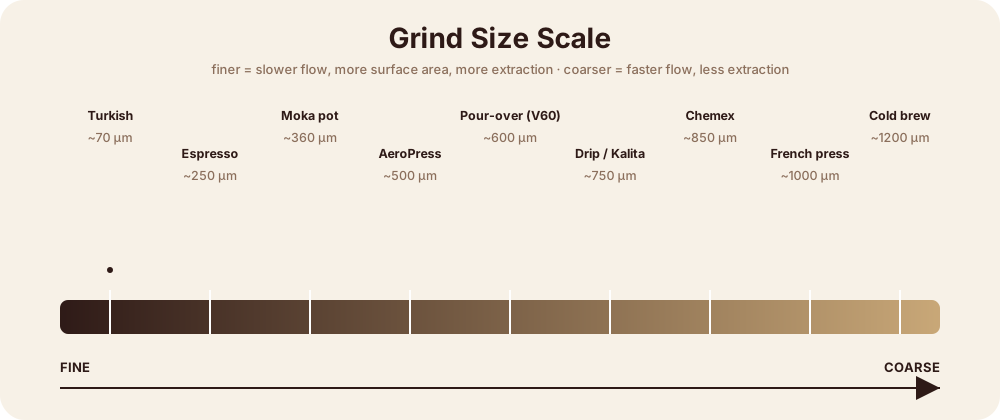
The Key is designed to cover both espresso and filter grinding. Its 83mm flat burrs produce a particle-size distribution that performs well across the full range from fine espresso to coarser pour-over and batch-brew settings, though flat-burr character particularly benefits espresso in terms of body and flavor clarity.
What does 'single-dose' mean in the context of the Key?
Single-dose means the Key has no retention hopper. You weigh your beans individually before each session and feed that exact dose into the grinder. The low-retention design ensures nearly all of what you put in comes out — minimizing stale grounds between sessions and allowing you to switch coffee varieties without cross-contamination or purging waste.
How does the Key compare to the Weber Workshops EG-1?
The EG-1 ($4,000) is Weber Workshops' flagship grinder, featuring larger burrs and additional features in a more fully-specified chassis. The Key ($2,050) is the more accessible entry into Weber's electric grinder lineup. Both share the brand's flat-burr, single-dose philosophy and premium metal construction; the EG-1 is the choice for buyers with no ceiling, while the Key delivers comparable Weber character at a lower price point.
How does the Key compare to the Weber Workshops HG-2?
The HG-2 ($1,600) is a hand grinder — it requires manual effort to grind each dose and is suited to users who prioritize quiet operation, portability, or the tactile workflow of hand-grinding. The Key is an electric grinder for users who want automated grinding without compromising on burr quality. They are complementary tools for different use cases rather than direct competitors.
Is the Key worth the premium over a 64mm flat-burr grinder like the Lagom P64?
The Key's 83mm burrs offer measurably more grinding surface area and thermal stability in back-to-back sessions compared to 64mm alternatives. Whether that difference justifies roughly $1,200–1,300 in additional cost depends on how seriously you evaluate extraction quality and how frequently you grind. For one daily double espresso, the gap is smaller than the price difference implies. For multi-session, multi-variety use by an engaged enthusiast, the advantages compound.
What colorways is the Key Mk.2 available in?
The Key Mk.2 is available in Snow and Onyx finishes, both executed in premium metal construction consistent with the rest of the Weber Workshops product line.
Does Weber Workshops sell replacement parts for the Key?
Weber Workshops maintains an active parts and accessories catalog, and the brand's design philosophy explicitly addresses long-term ownership. Replacement components are available through their website, consistent with their positioning of the Key as a durable precision instrument rather than a disposable consumer appliance.
Did the Key win any industry awards?
Yes. The original Key won Best New Product at the 2021 SCAA Expo — a peer-recognition award from the Specialty Coffee Association that reflects serious industry evaluation. The current Mk.2 is a refined iteration of that award-winning design.
What kind of espresso machine should I pair with the Key?
The Key's capabilities are best utilized with an espresso machine that offers meaningful temperature stability and pressure control — typically a machine in the $1,000-and-up range with E61 grouphead or better thermal management. Pairing a $2,050 grinder with a basic single-boiler machine leaves significant performance on the table, as the grinder's precision will surface inconsistencies in the machine rather than eliminate them.
How does the Key fit into a single-dose espresso workflow?
The Key is designed specifically around single-dose workflow: weigh your beans, drop them into the feed throat, grind directly into your portafilter or dosing cup, then distribute and tamp. The low-retention path means minimal grounds remain in the grinder between doses. Weber Workshops' own accessory ecosystem — including the Blind Shaker for distribution — is designed to integrate cleanly with this workflow.
More grinders
Baratza
Baratza Sette 270Wi
A fast, low-retention espresso grinder with built-in grind-by-weight dosing.
Niche
Niche Zero
The single-dose grinder that popularised low-retention conical grinding for home espresso.
1Zpresso
1Zpresso K-Ultra
A fast, versatile 48mm hand grinder with an intuitive external adjustment dial.
Eureka
Eureka Mignon Specialita
A quiet, reliable 55mm flat-burr espresso grinder and longtime prosumer staple.
We may earn a commission when you buy through links on this page, at no additional cost to you.
Last updated: June 13, 2026