Espresso Machine · Dual boiler (prosumer)
ECM Synchronika
ECM · $$$$
A flagship German dual-boiler machine prized for build quality and serviceability.
Price range
$3200 – $3800
ECM Synchronika on video
The Real Sprometheus covers the ECM Synchronika in a 9-minute video. Watch the review below, then see the details and where to buy — all without leaving the page.
The Real Sprometheus takes a hands-on look at the ECM Synchronika. We link it for its specs walkthrough and real-world impressions — form your own view by watching.
We may earn a commission when you buy through links on this page, at no additional cost to you.
More videos
Why this matters
The ECM Synchronika occupies a specific and important position in the prosumer espresso landscape: it is the machine for the home barista who has outgrown single-boiler or heat-exchanger limitations and wants a dual-boiler platform built to the same tolerances as commercial equipment — but handmade in Germany, not mass-produced in a factory. At $3,200–$3,800 USD, it sits at the upper edge of the home-use bracket, competing directly with the Decent DE1Pro, La Marzocco Linea Mini, and Breville Dual Boiler. What differentiates it from all three is the combination of fully serviceable internals, stainless-steel construction that resists corrosion over a decade of use, and an ECM build philosophy rooted in a family-run German manufacturing tradition. It is best suited to prosumers who pull multiple drinks per session, regularly steam milk for flat whites or cappuccinos, and intend to keep their machine for ten or more years. It is not for the occasional espresso drinker, someone on a budget, or anyone who values a compact countertop footprint. For those who match the profile, the Synchronika is among the most ownership-worthy dual-boiler machines available to consumers today.
At a glance
Best for
- Prosumers
- Longevity
- Milk drinks
Look elsewhere if
- Your counter space is limited: the Synchronika has a large footprint that will overwhelm smaller kitchens — consider the La Marzocco Linea Mini or ECM's own single-boiler models if depth and width are constrained.
- You primarily drink black espresso and never steam milk: the dual-boiler's simultaneous-steaming advantage is irrelevant for solo-espresso workflows, and a well-tuned single-boiler PID machine at half the price will produce equivalent shot quality.
- You want advanced pressure or flow profiling: the Synchronika offers no native pressure-profiling or flow-control capability; the Decent DE1Pro or a machine with an integrated flow-control device is a better fit for that workflow.
- Your budget cap is under $3,200: the Breville Dual Boiler delivers genuine dual-boiler performance at $1,400–$1,600 and is the rational choice if you are not committed to a decade-plus ownership horizon.
Closest alternatives
Featured in
**Build and Design**
The ECM Synchronika is manufactured by ECM, a family-owned company with production facilities in Germany and Italy, assembling each machine by hand according to what the brand describes as a commitment to detail and uncompromising quality standards. The exterior is stainless steel throughout, which is not merely cosmetic: stainless resists the corrosion, discoloration, and micro-cracking that afflict machines finished in painted ABS or chrome-plated plastic over years of steam and heat cycling. The machine uses a 58mm portafilter — the industry standard shared by La Marzocco, Rocket, Profitec, and the vast majority of prosumer brands — meaning every aftermarket basket, naked portafilter, tamper, and distributor in that ecosystem fits directly. This is a non-trivial advantage for espresso enthusiasts who already own or intend to build out a workflow with precision baskets such as IMS or VST, both of which are drop-in compatible.
The footprint is notably large for a home machine. The Synchronika's depth and width demand serious counter space — this is not a machine that squeezes beside a toaster. Height clearance must also be accounted for, as the machine is tall enough that low-hanging cabinets will block portafilter access or cup warming. Planning the installation before purchase is strongly advisable.
The design language is classic European prosumer: brushed stainless, clean lines, analog pressure gauges — typically one for the pump and one for the steam boiler — mounted front and center. Physical controls rather than a touchscreen interface keep the user in direct contact with the machine's state. The drip tray is generously sized and removable for cleaning. The cup tray on top is passive but is warmed by heat rising from the boilers, a practical benefit for pre-warming espresso cups without a separate step.
**Dual-Boiler Performance**
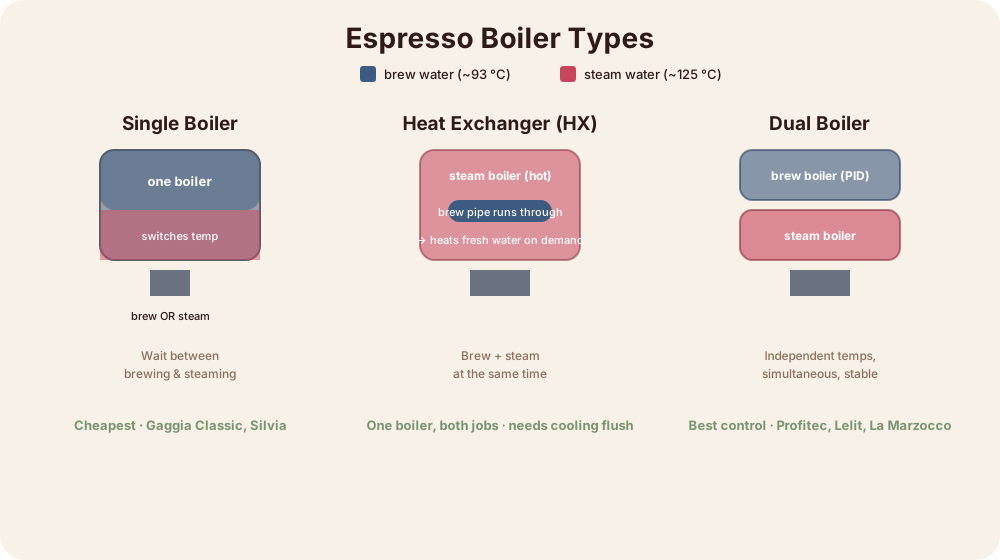
The Synchronika's defining technical feature is its dual-boiler configuration. Unlike a heat-exchanger machine — which runs brew water through a coil inside a single steam boiler, producing brew temperatures that are less directly controlled — the Synchronika maintains a dedicated brew boiler and a dedicated steam boiler, each regulated independently. This means the brew temperature can be dialed to a precise target and held there without interference from steaming activity, and the steam boiler runs at full steam pressure simultaneously. The practical result is that pulling a shot and steaming milk for a latte can happen in true parallel, without waiting for thermal recovery between functions — a capability that single-boiler and most heat-exchanger machines cannot match.
Brewing temperature stability is the critical metric for espresso consistency, and a properly functioning dual-boiler PID system — which the Synchronika employs — holds the brew boiler within a very tight variance around the set point. This directly translates to shot-to-shot repeatability: if your dialed-in recipe produces a particular flavor profile at 93°C, it will produce the same profile the next morning and the one after that, not a slightly hotter or cooler extraction caused by the machine's thermal state varying. Prosumers who blind-taste their own espresso across days consistently report tighter cup consistency from dual-boiler platforms than from heat-exchanger alternatives.
The rotary pump version of the Synchronika (as opposed to a vibratory pump, which ECM fits to lower-line models) operates significantly more quietly, produces less vibration, and is considered more durable over a long service life. It also enables plumbing directly into a water line, bypassing the reservoir entirely — a configuration preferred by high-volume users who do not want to interrupt workflow to refill.
**Day-to-Day Workflow**
Warm-up time is a practical consideration. A dual-boiler machine requires both boilers to reach operating temperature, which typically takes 20–30 minutes from a cold start — longer than a single-boiler machine. Many Synchronika owners use a timer outlet or smart plug to begin the warm-up cycle before waking, so the machine is ready when they enter the kitchen. Some machines in this class offer a built-in timer or scheduling feature; the Synchronika's controls support this workflow.
Maintenance intervals on the Synchronika follow standard prosumer practices: backflushing with cleaner weekly, descaling on a schedule dictated by local water hardness, and grouphead seal and screen replacement annually or when resistance changes. The serviceable design — a core ECM brand value — means internal components including the solenoid valves, pump, and boilers are accessible to a competent technician or an experienced owner. Replacement parts are available through ECM's dealer network. This serviceability is a direct contributor to long-term ownership economics: a Synchronika maintained properly has a realistic lifespan well beyond ten years, amortizing the premium purchase price significantly. Resale value for well-maintained ECM machines is also strong in the secondhand prosumer market.
The 58mm standard portafilter ecosystem means accessories are abundant and competitive in price. La Marzocco Linea Mini baskets, IMS precision baskets, Pullman and Ona competition baskets — all fit. This matters because the quality of the basket is among the most impactful variables in espresso extraction quality, and Synchronika owners are not locked into proprietary accessories.
**Honest Trade-offs**
The Synchronika's premium price — $3,200 to $3,800 USD depending on configuration and retailer — is the first and most important filter for prospective buyers. At that price, it competes in a bracket that includes the La Marzocco Linea Mini, the Profitec Pro 700, and the Decent DE1Pro, each of which offers a meaningfully different set of capabilities and trade-offs.
The large footprint is genuinely limiting. If your counter space is constrained, the Synchronika will not accommodate. This is not a criticism of the machine's engineering — dual-boiler systems require physical volume — but it is a real-world constraint that eliminates the Synchronika from consideration for many kitchens. The Profitec Pro 500 PID and ECM's own single-boiler models occupy significantly less counter space at lower prices, and for a solo espresso drinker who never steams milk, the dual-boiler advantage is largely irrelevant.
**Head-to-Head Comparisons**
*vs. La Marzocco Linea Mini*: The Linea Mini shares the dual-boiler architecture and 58mm standard. It carries stronger brand cachet in third-wave coffee culture and is notably compact for its class. The Synchronika counters with what reviewers consistently describe as superior build robustness and longer realistic service life, and is available in a plumbed rotary version at comparable price. The Linea Mini's saturated group is a genuine thermal mass advantage for back-to-back shots; the Synchronika's PID-controlled brew boiler achieves similar stability via a different mechanism.
*vs. Profitec Pro 700*: The Pro 700 is the most direct competitor — also German-made, also dual-boiler, also stainless, similarly priced. The two machines share a significant amount of component DNA, as both are manufactured in the same German facility. Choosing between them often comes down to cosmetic preference and minor ergonomic differences. The Synchronika's controls and aesthetics lean slightly more toward the traditional; the Pro 700's are marginally more contemporary. Performance is effectively equivalent at the espresso level.
*vs. Breville Dual Boiler*: The Breville Dual Boiler (BDB) is the value proposition against which every prosumer dual-boiler is measured, retailing around $1,400–$1,600 USD. It offers PID-controlled dual boilers, pressure profiling capability, and credible espresso performance at less than half the Synchronika's price. The honest comparison: the BDB is made from lighter materials with a shorter expected service life, and its components are not owner-serviceable to the same depth. For a buyer willing to replace a machine in five to seven years, the BDB is rational. For a buyer who wants a machine they service and keep for fifteen-plus years, the Synchronika's economics can close the gap.
*vs. Decent DE1Pro*: The Decent DE1Pro offers tablet-controlled pressure and flow profiling of a sophistication no traditional prosumer machine matches. For the espresso technologist who treats extraction as an active experiment, the DE1Pro's data-logging and profile flexibility are unmatched at any price. The Synchronika offers none of that. What it offers instead is mechanical simplicity, thermal mass reliability, and zero dependency on software updates or a tablet interface staying functional. Different philosophies, not a clear winner.
**Bottom Line**
The ECM Synchronika rewards the prosumer who values craft-built durability, a fully standard 58mm ecosystem, and genuine dual-boiler thermal independence, and who plans to keep a machine long enough for the premium to amortize. It does not reward the buyer seeking compact dimensions, digital profiling features, or value-first economics. In its intended use case, it is one of the most defensible prosumer investments in the category.
Pros
- Superb German build
- Stable dual-boiler performance
- Serviceable design
Cons
- Premium price
- Large footprint
Who reviewed it
We synthesized this page from independent reviews and the manufacturer's own materials. Conclusions below are paraphrased, not quoted.
Prima Coffee
Prima Coffee positions the Synchronika as one of the definitive prosumer dual-boiler machines for home use, emphasizing its German construction quality, independent boiler control, and suitability for serious milk-drink workflows.
Whole Latte Love
Whole Latte Love highlights the Synchronika's build robustness and long-term reliability, noting that the rotary pump version is especially well-suited to plumbed installations and high-volume home use.
ECM (Manufacturer)
ECM describes the Synchronika as a handmade German flagship representing the company's core values of quality, serviceability, and espresso precision, assembled in their own manufacturing facility.
Source ↗CoffeeGeek
CoffeeGeek's community consensus treats the Synchronika as a benchmark in the prosumer dual-boiler segment, frequently comparing it favorably to the Profitec Pro 700 given their shared manufacturing origins.
Home-Barista.com
Home-Barista's forum community consistently recommends the Synchronika for prosumers prioritizing thermal stability and owner-serviceability over digital features, while noting the large footprint as the primary practical drawback.
Frequently asked questions
What is the price range for the ECM Synchronika?
The ECM Synchronika retails between approximately $3,200 and $3,800 USD depending on configuration (reservoir vs. plumbed, vibratory vs. rotary pump) and the specific authorized dealer.
What portafilter size does the Synchronika use?
The Synchronika uses a 58mm portafilter, the industry-standard size shared by La Marzocco, Rocket, Profitec, and most prosumer brands. This means aftermarket baskets (IMS, VST, Pullman), naked portafilters, and tampers from the broader 58mm ecosystem are all directly compatible.
How is the Synchronika different from a heat-exchanger machine?
A heat-exchanger machine uses a single boiler for both steam and brew, running brew water through a coil inside the steam boiler — making brew temperature less directly controllable and requiring a purge before pulling a shot. The Synchronika has two fully separate boilers, one dedicated to brewing and one to steaming, each independently regulated by PID. This allows true simultaneous steaming and brewing with no thermal recovery wait.
How long does the Synchronika take to warm up?
As a dual-boiler machine, the Synchronika typically requires approximately 20–30 minutes from a cold start before both boilers reach stable operating temperature. Many owners use a timer outlet to begin the warm-up cycle automatically before their morning routine.
Is the ECM Synchronika serviceable at home?
Yes — ECM designs the Synchronika with serviceability as a core principle. Internal components including the solenoid valves, grouphead seals, screen, and pump are accessible to a qualified technician, and many experienced owners perform routine maintenance themselves. Replacement parts are available through ECM's authorized dealer network.
How does the Synchronika compare to the Profitec Pro 700?
The two machines are the most direct competitors in the prosumer dual-boiler segment and share manufacturing origins in the same German facility, resulting in very similar component quality and espresso performance. Differences largely come down to cosmetic design preference and minor ergonomic details. Both are stainless-steel, dual-boiler, 58mm machines in a similar price bracket.
Does the Synchronika offer pressure profiling?
The Synchronika does not offer built-in pressure or flow profiling. It is a traditional fixed-pressure dual-boiler machine. Buyers seeking advanced profiling should look at the Decent DE1Pro or consider adding a separate flow-control device, though the latter requires aftermarket modification.
Can the Synchronika be plumbed directly into a water line?
Yes, the rotary pump version of the Synchronika supports direct plumbing to a water line, bypassing the internal reservoir. This is preferred for high-volume users or those who want an uninterrupted workflow without refilling. The vibratory pump version operates from the reservoir only.
What routine maintenance does the Synchronika require?
Standard maintenance includes weekly backflushing with espresso machine cleaner, periodic descaling based on local water hardness (using softened or appropriately filtered water extends intervals significantly), and annual replacement of the grouphead seal and shower screen. Regular purging of the steam wand after each use is also essential.
How does the Synchronika compare to the Breville Dual Boiler?
The Breville Dual Boiler offers PID-controlled dual boilers and credible espresso performance at roughly $1,400–$1,600 USD — less than half the Synchronika's price. The trade-off is build material quality, depth of serviceability, and expected lifespan. The Synchronika is the better long-term investment for an owner planning 10–15+ years of use; the Breville is rational for a 5–7 year ownership horizon.
What kind of user is the Synchronika best suited for?
The Synchronika is best suited to prosumers who pull multiple espresso shots per session, regularly prepare milk-based drinks, and intend to keep their machine for a decade or longer. It is particularly well-matched to owners who value German build quality, a fully standard 58mm accessory ecosystem, and a machine they can maintain and service over time.
Where is the ECM Synchronika made?
The ECM Synchronika is made in Germany, assembled by hand at ECM's manufacturing facility. ECM is a family-owned company with production in both Germany and Italy, and describes its machines as handcrafted with a detail-oriented manufacturing philosophy.
Compare with
Lelit
Lelit Bianca
A prosumer dual-boiler machine famous for its manual flow-control paddle.
Profitec
Profitec Pro 300
A compact German dual-boiler machine offering simultaneous brewing and steaming.
More espresso machines
Lelit
Lelit Bianca
A prosumer dual-boiler machine famous for its manual flow-control paddle.
La Marzocco
La Marzocco Linea Mini
The home machine derived from La Marzocco's legendary commercial Linea.
Gaggia
Gaggia Classic Pro
An affordable single-boiler classic and one of the most modified machines in home espresso.
Decent Espresso
Decent DE1
A software-driven espresso machine offering complete pressure and flow profiling.
We may earn a commission when you buy through links on this page, at no additional cost to you.
Last updated: June 13, 2026