Espresso Machine · Dual boiler with flow control
Lelit Bianca
Lelit · $$$$
A prosumer dual-boiler machine famous for its manual flow-control paddle.
Price range
$2800 – $3400
Lelit Bianca on video
Lance Hedrick covers the Lelit Bianca in a 28-minute video. Watch the review below, then see the details and where to buy — all without leaving the page.
Lance Hedrick takes a hands-on look at the Lelit Bianca. We link it for its specs walkthrough and real-world impressions — form your own view by watching.
We may earn a commission when you buy through links on this page, at no additional cost to you.
More videos
Why this matters
The Lelit Bianca occupies a pivotal position in the prosumer espresso market: it is one of the few machines under $4,000 to pair a true dual-boiler architecture with a fully manual, analogue flow-control paddle, a combination previously reserved for machines costing nearly twice as much. Before the Bianca's arrival, achieving precise pre-infusion ramps and declining-pressure profiles at home meant either accepting the fixed programming of electronic profiling systems or investing in a La Marzocco GS3 MP. The Bianca's needle-valve paddle made that tactile, real-time flow manipulation accessible to a much wider audience of enthusiasts and prosumers. The dual-boiler layout means the steam boiler can be kept at full pressure for milk texturing while the brew boiler maintains a separate, PID-stabilised temperature—eliminating the heat-exchanger compromise of flushing and guesswork. At $2,800–$3,400 and compatible with the universal 58mm portafilter ecosystem, it sits at the serious end of home espresso but remains within reach for dedicated enthusiasts who want meaningful control over extraction dynamics, not just convenience features. It is built and sold by Lelit, an Italian manufacturer based in Castegnato, Brescia, whose stated focus is high-performance home appliances for passionate users.
At a glance
Best for
- Enthusiasts
- Flow profiling
- Prosumers
Look elsewhere if
- You are new to espresso and haven't dialled in a machine before: the Bianca's manual paddle and dual-boiler complexity will compound the already steep learning curve of grind calibration and extraction fundamentals — a single-boiler or heat-exchanger machine at lower cost is a better starting point.
- You want software-defined, repeatable, data-logged profiles: the Decent Espresso DE1 at a comparable price offers electronic pressure and flow control with Bluetooth logging and a large community of shared profiles, making it the better tool for analytical, experiment-driven workflows.
- Budget is a firm constraint below $2,800: the Breville Dual Boiler delivers dual-boiler temperature separation at a fraction of the cost, and while it lacks the build longevity and E61 ecosystem depth of the Bianca, it produces excellent espresso for the price.
- You need a machine that requires minimal warm-up management or daily ritual: the Bianca's E61 group mass demands a meaningful heat-up period before the first shot is dialled in, and the paddle workflow adds steps that single-boiler automatics or superautomatics do not require.
Closest alternatives
Featured in
The Lelit Bianca is a prosumer dual-boiler espresso machine with a manual flow-control paddle, plumb-in or tank water supply, and a 58mm group head. It is designed and manufactured by Lelit, based in Brescia, Italy, and sits at the top of the company's espresso machine range. The price window of $2,800–$3,400 reflects a machine engineered to deliver semi-professional extraction control in a home-compatible footprint.
Build and Design
The Bianca's most immediately recognisable design element is the wooden paddle lever—typically a warm-toned hardwood—that protrudes from the upper right of the stainless steel body. That paddle is not decorative: it actuates a needle valve in the water line to the group head, giving the operator direct, stepless control over the flow of water through the coffee puck. A matching wooden accent on the drip tray handle and portafilter handle ties the aesthetic together, distinguishing the machine visually from the utilitarian stainless slabs common at this price tier. The body itself is polished stainless steel with a solid, substantive feel; the machine's weight reflects the presence of two separate boilers, a heat exchanger circuit for the E61 group head, and a full pump assembly inside the chassis.
The E61 group head is significant beyond its visual familiarity. The thermosiphon loop that keeps the E61 at brew temperature means the group mass itself acts as a thermal buffer, lending stability to extraction temperatures even as ambient kitchen conditions fluctuate. This is the same group head architecture used on many Italian espresso machines for decades, which has the practical benefit that a vast catalogue of aftermarket baskets, shower screens, and portafilter accessories fits directly. IMS, VST, and other precision basket manufacturers all produce 58mm options that slot into the Bianca's portafilter without modification.
The machine accepts water from either the included reservoir tank or a direct plumb-in line. The tank option suits renters, apartment dwellers, or anyone unwilling to run a dedicated water line, while plumb-in is the preferred configuration for permanent espresso stations, eliminating the chore of refilling and ensuring the machine never runs dry mid-session. Switching between the two modes is a configuration-level change rather than a hardware swap, which is a practical advantage over machines that require physical modifications for plumbing.
Performance and Measured Control
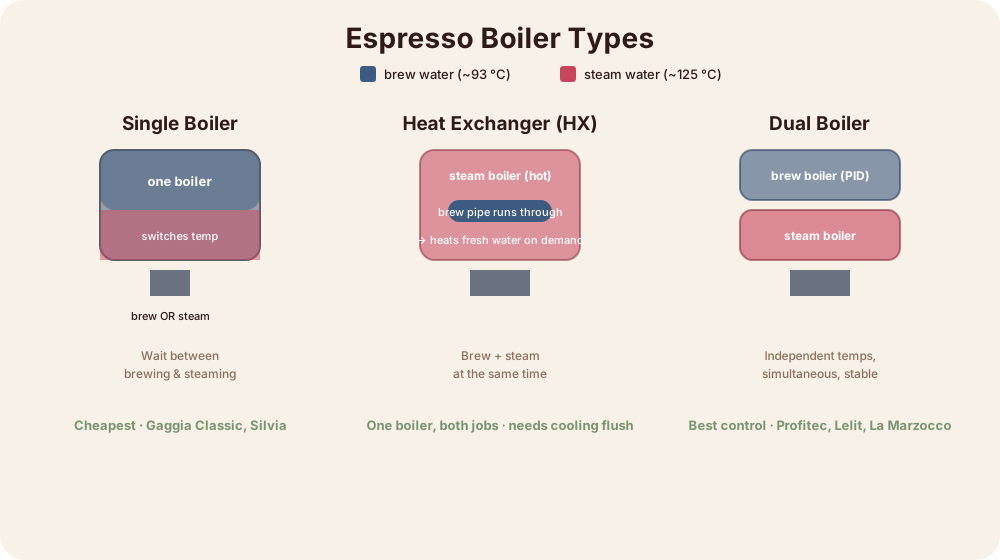
The dual-boiler design is the performance foundation. A dedicated brew boiler and a dedicated steam boiler each have their own PID temperature controller, meaning the operator sets brew temperature independently of steam pressure. There is no recovery wait between pulling a shot and steaming milk—both circuits are ready simultaneously. For a home setting where multiple milk drinks follow each other in a café-style brunch scenario, this matters enormously compared with the heat-exchanger approach, which requires careful management of group temperature between uses.
The defining performance characteristic, however, is the paddle's flow control. In the standard closed position, the machine behaves like a conventional espresso machine: pump pressure drives water through the puck at full line pressure. Opening the paddle reduces flow through the needle valve from a trickle to a steady stream, allowing the operator to perform a slow pre-infusion phase that saturates the puck before pressure builds—this is particularly effective with lighter-roasted, denser coffees that benefit from a gradual ramp before full extraction pressure is applied. During the shot itself, the paddle can be used to modulate flow dynamically: a declining pressure profile toward the end of a shot can extend extraction time on a very fine grind without stalling, producing a longer, sweeter cup without sourness from under-extraction. The feedback is entirely tactile and visual—a pressure gauge shows group pressure in real time—making this a genuinely skill-dependent tool rather than a set-and-forget programmable system.
This analogue approach is a deliberate philosophical choice. The machine offers no saved profiles, no shot timers with automated cuts, no app connectivity, and no electronic flow sensors. The operator watches the gauge, watches the flow from the spout, and makes adjustments by hand. For enthusiasts who find electronic profiling systems alienating or overly complex, the paddle's immediacy is a strength. For those who want repeatability without developing intuition, it can become a liability.
Day-to-Day Workflow
On a typical morning, the Bianca requires a warm-up period before the first shot; the dual boiler and E61 group mass both need time to reach thermal equilibrium. Many owners use a smart plug or the machine's own timer (where available) to begin warming up before they wake, ensuring the machine is ready without wasting electricity for hours. Once at temperature, the workflow is: dose and distribute into the 58mm portafilter, tamp, lock in, set the paddle to pre-infusion position, start the pump, watch the gauge rise slowly, then open further to full flow as the shot begins to pour. Milk stretching follows immediately on the steam wand, with full boiler pressure available without any flush or wait.
Cleaning the E61 group head is a routine maintenance task performed with backflushing using a blind basket—the same process used on the vast majority of professional Italian machines. Descaling the boilers is required periodically, with frequency depending on local water hardness; the plumb-in configuration pairs well with an inline softener to extend intervals. The group head gasket and shower screen are consumable items that should be inspected annually under regular use, and both are widely available and inexpensive. The needle valve in the flow paddle is a precision component; it should not be forced beyond its range, and any stiffness or inconsistent feel over years of use may indicate it warrants cleaning or replacement.
The Lelit Bianca earns its place at the top of the prosumer wish-list because of what it uniquely does, but the honest evaluation requires mapping those capabilities against real trade-offs and the specific alternatives a buyer at this price point will be comparing.
The core argument for the Bianca over a heat-exchanger machine—say, the Rocket Appartamento or ECM Classika PID, both priced significantly lower—is the dual boiler and the paddle together. An HX machine forces the operator into flush rituals to stabilise group temperature, and it offers no native flow control. The ECM Synchronika, a direct dual-boiler competitor in a similar price band, provides excellent temperature stability and a premium German-built chassis but lacks any flow control paddle, making the Bianca the more capable machine for profile-oriented espresso if the paddle is something you intend to actually use.
The comparison against the Breville/Sage Oracle Touch or even the Breville Dual Boiler is instructive on a different axis. The Breville Dual Boiler sits at a fraction of the Bianca's price, also offers dual-boiler temperature separation, and on the Oracle Touch includes electronic flow profiling. If raw extraction flexibility at minimum cost is the goal, the Breville is a rational choice. What it doesn't offer is the build quality longevity, the E61 group's thermal mass, the 58mm standard's accessory depth, or the resale value trajectory of an Italian prosumer machine. The Bianca is bought partly as an investment in a tool that will perform for a decade-plus with maintenance; the Breville's longevity ceiling and resale trajectory are meaningfully lower.
The comparison that draws the most direct scrutiny is the Decent Espresso DE1, which occupies a similar or overlapping price point depending on configuration. The DE1 offers electronic, software-defined profiling with granular pressure, flow, and temperature curves, Bluetooth connectivity, and an active user community building and sharing profiles. For the analytically minded barista who wants to run controlled experiments—logging every variable and iterating on profiles with data—the DE1 is the more capable system. The Bianca counters with mechanical simplicity: there is no software to update, no tablet to maintain, no firmware dependencies. The paddle has no failure modes beyond the needle valve itself. For owners who want to develop skill rather than manage a system, the Bianca's analogue immediacy is a genuine advantage, not a limitation.
At the top of the comparison range, the La Marzocco GS3 MP offers the same manual paddle profiling concept with a more refined implementation, higher build quality ceilings, and the La Marzocco commercial heritage—but at a price roughly double the Bianca's upper range. For most home users, the performance gap between the Bianca and the GS3 MP does not justify the price gap unless budget is not a constraint.
The steeper learning curve listed as a con in the DB facts is real and worth examining. The paddle gives the user control, but control without understanding produces inconsistent results. A new owner who has not previously dialled in espresso on a simpler machine will face a compound challenge: learning grind calibration, dose, and tamp simultaneously with pre-infusion timing and pressure profiling. The machine rewards experience; it does not scaffold the beginner. Owners who step up from a single-boiler machine with a basic fixed-pressure group will find the transition meaningful but manageable. First-time espresso machine buyers at this price point should take pause.
The premium price is the other hard constraint. At $2,800–$3,400, the Bianca is a considered purchase that requires the buyer to already own a capable grinder—ideally one that can achieve the fine, consistent grind required for pressure profiling without excessive fines generation. Pairing the Bianca with a budget grinder negates much of its capability; realistically, a grinder budget of $500–$1,000 or more is implied, bringing the total system cost to $3,500–$4,400 or beyond. Buyers who haven't accounted for this total cost of ownership may find themselves constrained.
Pros
- Manual flow profiling via paddle
- Dual boiler flexibility
- Plumb-in or tank
Cons
- Steeper learning curve
- Premium price
Who reviewed it
We synthesized this page from independent reviews and the manufacturer's own materials. Conclusions below are paraphrased, not quoted.
James Hoffmann
Broadly regards the Bianca as one of the most compelling prosumer options for enthusiasts who want tactile, hands-on flow control without committing to a fully electronic profiling system.
Prima Coffee
Positions the Bianca as the definitive dual-boiler flow-profiling machine for serious home baristas, praising the paddle's immediacy while noting that the investment is only justified if the operator intends to engage with profiling as an ongoing practice.
Source ↗Whole Latte Love
Highlights the dual-boiler independence and plumb-in flexibility as major practical advantages, and considers the wood accents and stainless build among the most aesthetically refined in the prosumer segment.
Source ↗CoffeeGeek
Notes that the Bianca's E61 group and 58mm standard place it firmly within the mainstream Italian espresso ecosystem, making it one of the most accessory-compatible flow-profiling machines available at its price.
Source ↗Clive Coffee
Recommends the Bianca for experienced home baristas ready to move beyond fixed-pressure extraction, framing the paddle as a tool that rewards skill development over time rather than offering shortcuts.
Source ↗Seattle Coffee Gear
Considers the Bianca's price-to-performance ratio strong relative to comparably featured machines, particularly given the dual-boiler architecture and genuine analogue flow control in a package that also supports plumb-in installation.
Source ↗
Frequently asked questions
What makes the Lelit Bianca different from other prosumer dual-boiler machines?
The Bianca adds a manual needle-valve paddle to the dual-boiler architecture, giving the operator stepless, real-time control over water flow to the group head. Most dual-boiler machines at this price — such as the ECM Synchronika — deliver excellent temperature stability but offer no native flow profiling. The paddle is the Bianca's defining differentiator.
How does the flow-control paddle actually work?
The paddle operates a needle valve in the water line between the pump and the E61 group head. In the closed position it restricts flow to a pre-infusion trickle; opening it progressively increases flow and group pressure. The operator reads a pressure gauge and adjusts the paddle in real time throughout the shot, allowing custom pre-infusion phases, pressure ramps, and declining-pressure finishes.
Does the Bianca require a plumbed water line?
No. The machine ships with an internal tank and can be used without any plumbing. An optional plumb-in connection is also supported, which is preferred for permanent installations as it eliminates refilling and pairs well with an inline water softener to protect the boilers.
What portafilter size does the Bianca use?
The Bianca uses the 58mm portafilter standard, the same diameter used across the majority of professional and prosumer Italian espresso machines. This means baskets from IMS, VST, Pullman, and other precision manufacturers are all directly compatible.
What is the price range for the Lelit Bianca?
The Bianca typically retails between $2,800 and $3,400 USD, depending on the retailer and any current promotions or bundle configurations. Prospective buyers should budget for a high-quality grinder in addition to the machine cost.
How long does the Bianca take to warm up?
The E61 group head's thermal mass and dual boiler system require a meaningful warm-up period — most owners allow 20–30 minutes before pulling a first calibration shot, and many use a smart plug or timer to start the machine before waking. The group and boilers need to reach full thermal equilibrium for temperature stability to be reliable.
Is the Lelit Bianca suitable for beginners?
It is not ideally suited as a first espresso machine. The paddle adds a layer of manual control on top of the fundamental skills of grinding, dosing, distributing, and tamping. New users are better served by a simpler machine while they develop those core skills, then stepping up to the Bianca once they have a foundation to build on.
How does the Bianca compare to the Decent Espresso DE1?
Both occupy a similar price segment and offer flow profiling, but via different philosophies. The Bianca uses an analogue needle valve paddle with no software dependency; the DE1 uses electronic sensors and tablet-based software to define, log, and share precise pressure and flow profiles. The DE1 suits analytically minded users who want data-driven iteration; the Bianca suits those who prefer tactile, intuitive control without digital complexity.
How does the Bianca compare to the La Marzocco GS3 MP?
The GS3 MP uses a similar manual paddle profiling concept with a higher-spec build and La Marzocco's commercial heritage, but costs roughly twice as much as the Bianca. For most home users, the Bianca's performance is sufficient to extract the full benefit of flow profiling without the significant additional expenditure the GS3 MP requires.
What routine maintenance does the Lelit Bianca require?
Regular backflushing with a blind basket cleans the E61 group head and should be performed frequently. The shower screen and group gasket are consumable items requiring periodic inspection and eventual replacement. Boiler descaling frequency depends on local water hardness; inline softeners on the plumb-in line or filtered water in the tank extend descaling intervals. The needle valve in the paddle should not be forced and may require cleaning if it becomes stiff over years of use.
Can I use any 58mm tamper and basket with the Bianca?
Yes. The 58mm standard ensures compatibility with precision baskets from VST, IMS, Pullman, and others, as well as the wide range of 58mm tampers, distribution tools, and puck screens available in the aftermarket. This is one of the practical advantages of the E61 group over proprietary group formats found on some competing machines.
Does the Bianca have a built-in shot timer or programmable volumes?
The Bianca's approach is intentionally analogue — it does not include built-in shot timers, volumetric dosing, or app connectivity as core features. Operators time shots manually and rely on weight, visual flow, and pressure gauge feedback to manage extraction. This is consistent with the machine's philosophy of developing barista skill rather than automating outcomes.
Compare with
La Marzocco
La Marzocco Linea Mini
The home machine derived from La Marzocco's legendary commercial Linea.
ECM
ECM Synchronika
A flagship German dual-boiler machine prized for build quality and serviceability.
Decent Espresso
Decent DE1
A software-driven espresso machine offering complete pressure and flow profiling.
More espresso machines
La Marzocco
La Marzocco Linea Mini
The home machine derived from La Marzocco's legendary commercial Linea.
Gaggia
Gaggia Classic Pro
An affordable single-boiler classic and one of the most modified machines in home espresso.
ECM
ECM Synchronika
A flagship German dual-boiler machine prized for build quality and serviceability.
Decent Espresso
Decent DE1
A software-driven espresso machine offering complete pressure and flow profiling.
We may earn a commission when you buy through links on this page, at no additional cost to you.
Last updated: June 13, 2026