Guides · Brewing
How to Brew French Press Coffee
A step-by-step recipe for rich, full-bodied coffee — plus the fixes for every common problem
Key facts
- Also called
- Cafetière, coffee plunger, cafetière à piston
- Brewing method
- Full-immersion brewing with direct water contact
- Coffee-to-water ratio
- 30 g coffee to 500 ml water
- Water temperature
- 93–96 °C (199–205 °F)
- Grind size
- Coarse, about texture of cooking salt
- Steep time
- Approximately 4 minutes
What Makes French Press Different
The French press — known variously as a cafetière in Britain and Ireland, a coffee plunger in Australia and New Zealand, and a cafetière à piston in its native French — is one of the oldest and most satisfying ways to brew coffee at home. Unlike pour-over or espresso, which force water through a paper or metal filter under pressure or gravity, the French press is a full-immersion brewer: the ground coffee sits in direct contact with hot water for the entire steep. This is the defining characteristic of immersion brewing, and it has real consequences for the cup — more body, more oils, and a richer, heavier mouthfeel than you'll find from a dripper.
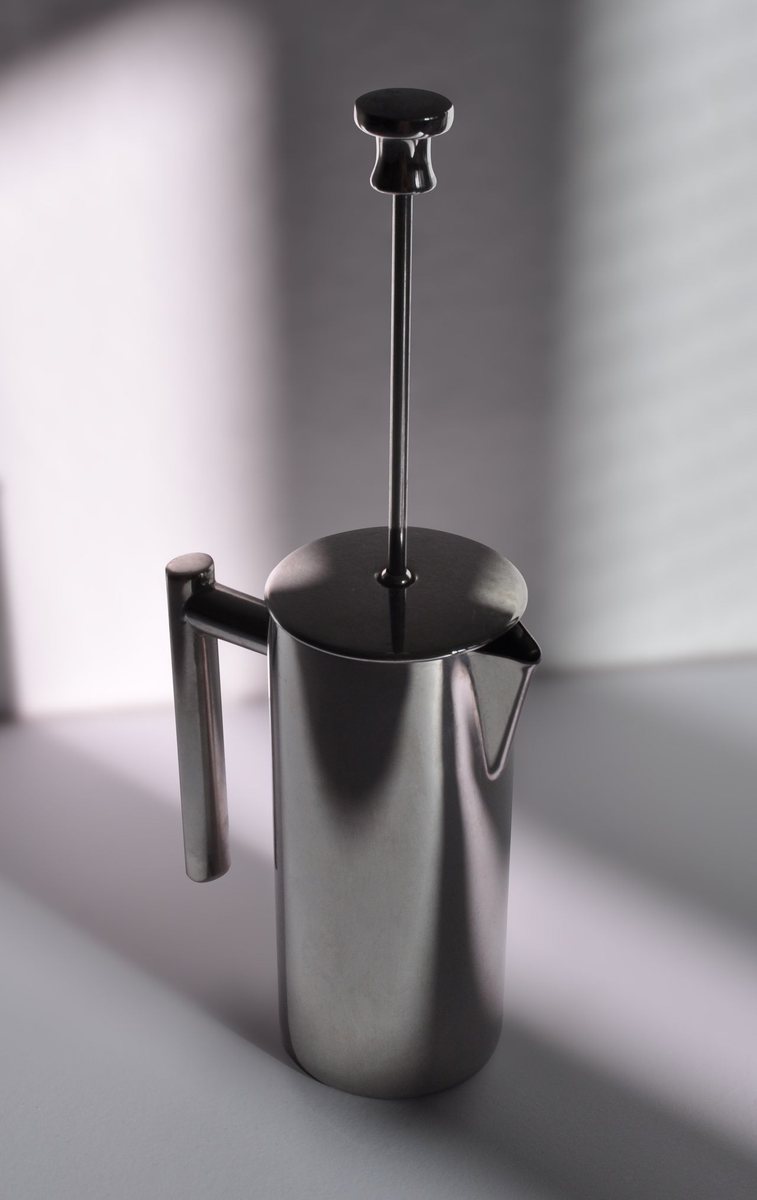
The device itself is elegantly simple. A narrow cylindrical beaker — most commonly glass — holds the coffee and water. A metal or plastic lid sits on top, threaded onto a plunger fitted with a fine stainless-steel wire or nylon mesh filter. Press down, and the filter holds the grounds at the bottom while you pour. That's it. No paper, no electricity, no pods.
A Brief History
The French press has a surprisingly tangled origin story. A rudimentary forerunner — little more than a metal or cheesecloth screen pressed into a pot — appeared in France around the mid-nineteenth century, and in 1852 Parisian metalsmith Henri-Otto Mayer and merchant Jacques-Victor Delforge patented a version that lacked a proper seal. The design remained impractical until 1928, when Milanese designers Giulio Moneta and Attilio Calimani created a press with a spring to seal the filter, patenting it in the United States in 1929. Further refinements came from Faliero Bondanini, who patented his own version in 1958 and manufactured it in a French clarinet factory under the brand name Melior. The design was later popularized across Europe by Melior-Martin, the British company Household Articles Ltd., and the Danish kitchenware company Bodum, whose Chambord model remains a benchmark of the form.
If you want a reliable, classic brewer to follow along with this guide, the Bodum Chambord French Press is the obvious starting point: its proportions are well-suited to the recipe below, and its wide availability makes replacement parts easy to source.
The Recipe at a Glance
Before diving into the step-by-step, here are the numbers you need:
- Ratio: 30 g of coffee to 500 ml of water (roughly 1:17 by mass, which falls comfortably within the broadly recommended brew ratio range of 15–18:1)
- Water temperature: 93–96 °C (199–205 °F)
- Grind size: Coarse — about the texture of coarse cooking salt
- Steep time: ~4 minutes
These figures are grounded in the device's operating principles. Water in the 93–96 °C range extracts efficiently without scorching the grounds; a coarser grind prevents over-extraction and keeps the plunger from requiring excessive force. The 4-minute steep is cited by multiple sources as the sweet spot for a balanced cup.
Step-by-Step: How to Brew
1. Grind Your Coffee
Grind size is the single variable that most brewers get wrong. The French press demands a coarse grind — the consistency of cooking salt, not fine beach sand. Finely ground coffee creates two problems: it clogs the mesh filter (requiring dangerous force on the plunger) and, more importantly, it massively increases the surface area exposed to hot water, producing over-extraction and a harsh, bitter cup. As grinding and particle size research confirms, matching grind coarseness to brew time is fundamental: longer-contact methods like immersion brewing require coarser particles.
For consistent, repeatable results, a burr grinder is essential. A blade grinder produces uneven particle sizes that guarantee an uneven extraction — some grounds over-extracted, others under. The Baratza Encore ESP is an excellent entry-level burr grinder well-suited to French press; set it toward the coarser end of its range (around setting 20–28, depending on your bean) and you'll have the right foundation.
Grind fresh, immediately before brewing. Whole beans preserve volatile aromatics that start to degrade the moment the bean is broken open.
2. Preheat and Measure
Pour a small amount of hot water into the empty French press and swirl it around for 30 seconds, then discard. This preheating step stabilises the brewing temperature: a cold glass beaker will pull heat from your water rapidly, dropping you below the optimal 93–96 °C window before extraction is complete.
Measure 30 g of coarsely ground coffee and add it to the empty, preheated beaker. Place the press on a scale if you have one — consistency is easier to replicate when you're working by weight rather than scoops.
3. Add Water and Start Your Timer
Bring water to the boil, then let it rest off the heat for 30–45 seconds if you lack a temperature-controlled kettle. This should bring it into the 93–96 °C range.
Pour the water slowly and evenly over the grounds, aiming for 500 ml total. Try to saturate all the grounds as you pour — a spiral pour from the outside in works well. You'll see an immediate bloom as CO₂ escapes from freshly roasted coffee; this is a good sign.
Once the water is in, give the slurry a gentle stir with a long spoon or chopstick to ensure all grounds are fully saturated. Place the lid on top with the plunger pulled all the way up — this traps heat. Start your timer now.
4. Steep for Four Minutes
Leave the press completely undisturbed for 4 minutes. Resist the urge to press early. Immersion brewing relies on sustained contact between water and grounds; cutting the steep short produces an under-extracted, thin, and sour cup. Going significantly over 4 minutes can tip into over-extraction territory, especially with finer grinds.
If your coffee tastes sour or weak after 4 minutes, try extending to 4:30. If it tastes bitter or harsh, reduce to 3:30 — or, more reliably, dial your grind coarser.
5. Skim the Crust — The Key Technique for a Clean Cup
At the end of your 4-minute steep, you'll notice a floating crust of grounds and foam on the surface. Do not skip this step: use two spoons to gently skim and discard this crust before you plunge. The crust contains a concentrated layer of grounds and spent oils that, if pushed down into the cup, contribute the gritty, murky texture that gives French press coffee its bad reputation.
Once skimmed, let the press sit undisturbed for another 30–60 seconds. This allows the remaining suspended grounds to settle toward the bottom before you plunge.
6. Plunge Slowly
Press the plunger slowly and steadily, applying even, downward pressure. The descent should take about 20–30 seconds. Plunging too fast can create turbulence that stirs up settled grounds and forces fine particles through the mesh; it can also cause hot liquid to splash dangerously. A slow plunge is both safer and produces a cleaner result.
If the plunger resists significantly, stop and don't force it — your grind is likely too fine. Forcing a stiff plunger risks scalding yourself. Pull it back up, wait a moment, and try again; if resistance persists, note it for the next brew and coarsen your grind.
7. Decant Immediately
This is the step that separates a good French press cup from a great one. Do not leave brewed coffee sitting on the grounds. Even with the plunger pressed, residual heat and the continued presence of grounds will keep extraction going, and the coffee will become progressively more astringent and bitter the longer it sits. Decant into a prewarmed carafe, thermos, or cups immediately after plunging.
If you're brewing for one and drinking straight from the press, pour immediately and drink promptly.
Troubleshooting
The coffee tastes bitter or harsh
- Grind is too fine — this is the most common cause. Coarsen your grind by 2–3 steps.
- Water is too hot. Let it cool slightly longer off the boil.
- Steep time is too long. Try reducing to 3:30.
- Coffee was left on the grounds after plunging. Always decant immediately.
The coffee tastes sour, weak, or thin
- Grind is too coarse — try going slightly finer.
- Water was not hot enough. Check your temperature.
- Steep time was too short. Extend to 4:30.
- Ratio is off — try increasing your coffee dose slightly (up to 33–35 g per 500 ml).
The cup is full of silt and grit
- Grind is too fine — fine particles pass through the mesh filter.
- Skimming step was skipped — the crust, when plunged, pushes fine grounds through.
- Plunging was too fast — slow down and allow grounds to settle before plunging.
- Check the mesh filter for wear or damage; replace if the filter is bent or has gaps.
The plunger is very hard to press
- Grind is too fine. Do not force it. Coarsen your grind for the next brew.
- Possible grounds trapped at the rim of the filter — ensure your grind is even.
The coffee goes cold too fast
- Preheat the beaker more thoroughly before brewing.
- Consider a stainless steel insulated French press, which functions like a thermos flask and retains heat significantly longer than a glass beaker.
- Decant immediately into a prewarmed insulated carafe.
Water and Ratio: Going Deeper
The 30 g / 500 ml starting point is a solid baseline, but brewing ratios are personal. Preferred brew ratios of water to coffee often fall in the range of 15–18:1 by mass, and even within that relatively small window, the difference is perceptible to an experienced palate. A 15:1 ratio (roughly 33 g per 500 ml) produces a denser, more intense cup; 18:1 (around 28 g per 500 ml) is lighter and more delicate. Explore the range and find what suits your taste and the particular coffee you're using.
Water quality matters too. Heavily chlorinated tap water will interfere with flavour; filtered water is recommended. Very soft water can under-extract; very hard water can over-extract and taste flat. If you're brewing with specialty coffee and not getting the result you expect, water composition is worth investigating.
Choosing the Right Coffee
The French press's full-immersion, unfiltered nature means the roast character comes through with unusual clarity. Medium to medium-dark roasts tend to shine here — the heavy body of the brew complements their chocolate, caramel, and nutty notes. Lighter roasts work beautifully too, particularly washed Ethiopian or Colombian coffees with floral and fruit character, though these can be more sensitive to overextraction, so keep your grind on the coarser side and your temperature toward the lower end of the range (93 °C).
Because immersion brewing is less selective than paper filtration, the oils and fine particles that paper would trap end up in your cup. This is precisely what gives French press its characteristic body — but it means coffee with defects or stale roasts will have nowhere to hide. Buy freshly roasted beans, store them in an airtight container away from light and heat, and grind immediately before brewing.
Equipment Summary
| Item | Recommendation | Notes |
|---|---|---|
| Brewer | Bodum Chambord French Press | Classic glass design, 8-cup (1 L) or 3-cup (350 ml) available |
| Grinder | Baratza Encore ESP | Entry-level burr grinder; consistent coarse grind |
| Scale | Any kitchen scale with 0.1 g resolution | Consistency is the goal |
| Kettle | Temperature-controlled preferred | Target 93–96 °C |
For more on how grinding affects extraction across all brew methods, see our grinding and particle size guide.
Gear for this
Frequently asked questions
- What is the correct coffee-to-water ratio for a French press?
- A reliable starting point is 30 g of ground coffee to 500 ml of water — approximately a 1:17 ratio by mass. Broadly, brew ratios between 15:1 and 18:1 are considered standard, with 15:1 producing a stronger cup and 18:1 a lighter one. Adjust within that range to suit your taste.
- How coarse should I grind coffee for a French press?
- Coarse — roughly the texture of coarse cooking salt. A grind that is too fine will over-extract (producing bitterness), clog the mesh filter, and require dangerous force on the plunger. A burr grinder set toward its coarser range is strongly recommended over a blade grinder for consistency.
- How long should I steep French press coffee?
- Around 4 minutes is the widely cited optimal steep time. If your cup tastes sour or thin, try 4:30; if it tastes bitter, try 3:30 — or, more effectively, coarsen your grind rather than shortening the steep.
- Why is my French press coffee full of silt and grit?
- The most common causes are a grind that is too fine (fine particles pass straight through the mesh), skipping the skim-and-settle step before plunging, or plunging too quickly. Skim the floating crust after steeping, let the brew settle for 30–60 seconds, then plunge slowly and steadily.
- Why does my French press coffee taste bitter?
- Bitterness is almost always a sign of over-extraction. The most likely culprits are a grind that is too fine, water that is too hot (above 96 °C), too long a steep, or — very commonly — leaving the brewed coffee sitting on the grounds after plunging. Always decant immediately.
- What water temperature should I use for French press?
- 93–96 °C (199–205 °F). If you don't have a temperature-controlled kettle, bring water to a full boil and let it rest off the heat for 30–45 seconds before pouring.
- Do I need to decant after pressing?
- Yes — this step is critical. Even with the plunger pressed down, brewed coffee left in contact with the grounds continues to extract, turning increasingly astringent and bitter. Pour into cups or a prewarmed carafe immediately after plunging.
See also