Knowledge · process
Drying Coffee
How freshly processed coffee reaches export-stable moisture — methods, mechanics, and why drying defines the cup
Key facts
- Target moisture
- 10–12% for storage and export
- Also called
- Raised drying beds, elevated beds
- Dominant in
- East Africa: Ethiopia, Kenya, Rwanda
- Drying duration
- Two to six weeks sun-dried naturals
- Key risk
- Case hardening from uneven moisture removal
- Typical bed height
- 0.8–1.2 metres above ground
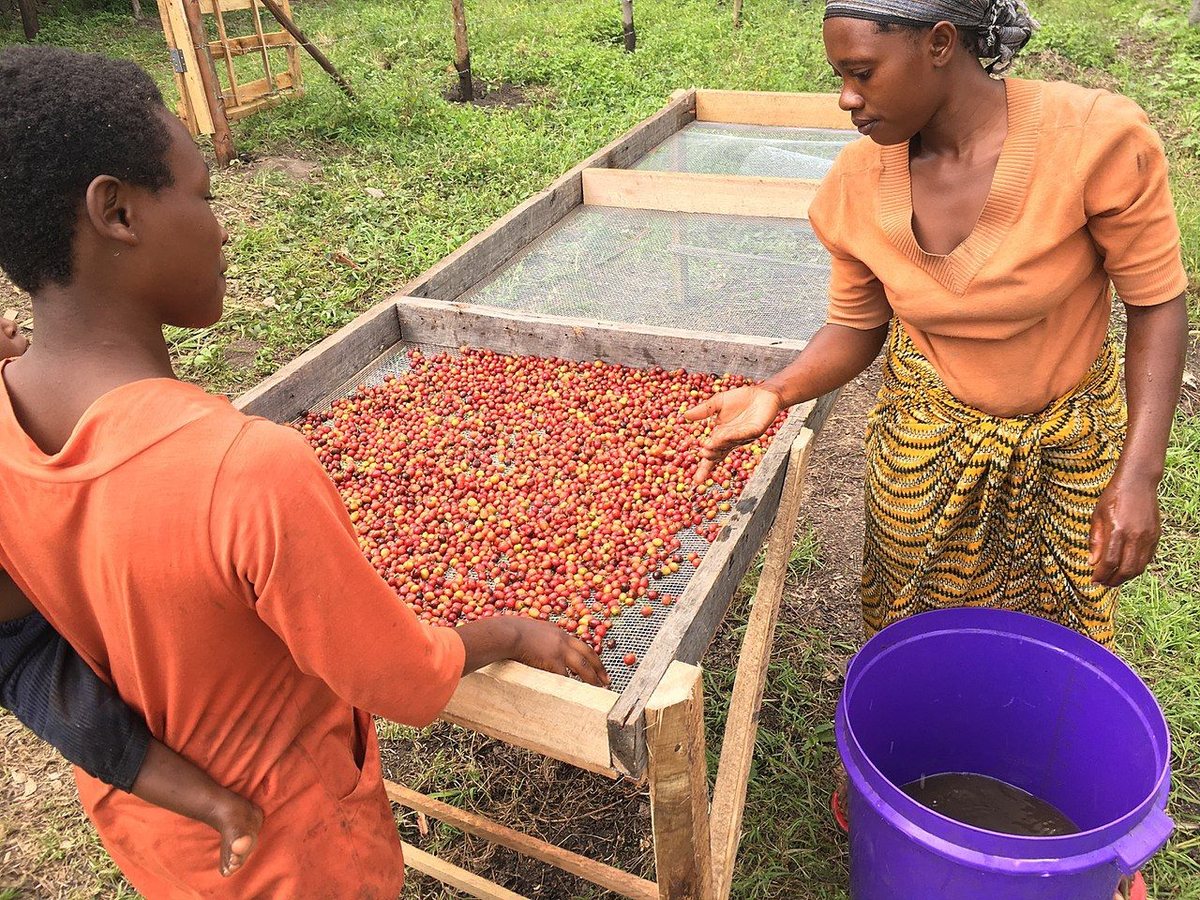
What Is Coffee Drying and Why It Matters
Coffee processing transforms the ripe coffee cherry into an exportable green bean, but it is drying that completes the transformation and determines whether that quality is preserved or lost. After pulping, fermentation, washing, or whole-cherry sun-drying — depending on whether a washed, natural, honey, or anaerobic method was used — the seed still carries a large and biologically active moisture load. Freshly pulped, washed parchment coffee typically enters drying at around 40–50% moisture; whole, undepulped cherries in the natural process carry even more.
At these moisture levels the coffee is highly vulnerable. Residual sugars and organic matter on and around the bean provide a substrate for microbial activity — mold growth, unwanted fermentation, and enzymatic breakdown can all proceed rapidly at high moisture and ambient temperatures. The goal of drying is to remove free and bound water systematically until the moisture content stabilizes at roughly 10–12% — the range broadly accepted by the specialty coffee trade and international standards as suitable for storage, milling, and export. Water activity (Aw), a measure of the fraction of water that is freely available for chemical and microbial reactions, is an equally important but often under-discussed parameter: a bean at 11% moisture can still carry elevated water activity if drying was uneven, leaving it prone to mold even when the bulk moisture reading appears acceptable.
Understanding drying is therefore inseparable from understanding green coffee quality and stability. Defects such as black beans, sour beans, fungal damage, and faded appearance are frequently traceable to poor drying practice — too fast, too slow, too uneven, or interrupted.
The Drying Curve
Drying coffee is not a linear process; it follows a characteristic drying curve with distinct phases, each requiring different management.
Phase 1 — Free-water evaporation. Immediately after processing, the outer surfaces of parchment or cherry carry abundant free moisture. Evaporation is rapid and largely surface-driven. Air movement, temperature, and surface area all have strong effects. Because water is plentiful at the surface, the coffee is not easily over-dried in this phase, but it is extremely vulnerable to contamination if hygiene is poor or if rainfall interrupts the process and allows re-wetting and renewed fermentation.
Phase 2 — Capillary and bound-water removal. As surface moisture is depleted, the rate of drying slows. Water must migrate from the interior of the bean outward through the parchment layer (in washed coffee) or through the drying mucilage and fruit layers (in natural and honey coffees). This phase is the most critical for quality: if the external environment removes moisture from the surface faster than the interior can supply it, a phenomenon known as case hardening can occur — a hard dry shell forms while the core remains wet, trapping moisture unevenly inside the bean.
Phase 3 — Equilibrium approach. In the final stage, moisture levels approach equilibrium with the surrounding air humidity. Drying slows markedly, and the bean gradually settles toward the target 10–12% range. Rushing this phase through high heat risks thermally stressing the bean; finishing too early leaves excess moisture that will cause problems in storage.
The total duration of drying varies significantly. Sun-dried naturals spread on raised beds in ideal conditions may take two to six weeks; washed parchment on a well-managed patio may complete primary drying in one to three weeks. Mechanical drying can dramatically compress this timeline, sometimes to a matter of hours or days, depending on the machine settings and the initial moisture load.
Raised African Drying Beds
Raised African beds — also called raised drying beds or elevated beds — are the dominant drying method in East African origins such as Ethiopia, Kenya, and Rwanda, and are widely adopted wherever specialty producers seek maximum quality control. Their construction is simple: a mesh or wire screen surface is stretched across a wooden or metal frame, typically elevated 0.8–1.2 metres above the ground. Coffee is spread in a thin, even layer across this mesh surface.
The elevation is the critical design feature. Air circulates freely both above and below the coffee layer, which dramatically increases the effective drying rate compared to a flat concrete surface and, more importantly, promotes even moisture removal from all sides of the bean simultaneously. On a solid surface, the underside of a coffee layer sits in its own moisture, creating differential drying between top and bottom.
Key operational practices on raised beds include:
- Turning frequency: Coffee must be turned regularly — often multiple times per day in the early wet phases — to prevent clumping, ensure all surfaces are exposed to airflow, and interrupt any localized anaerobic pockets that could trigger unwanted fermentation.
- Layer depth: Deeper layers slow drying and increase the risk of uneven moisture gradients. Thin layers (commonly 3–5 cm for washed parchment, deeper for naturals in early stages) are preferred, with depth gradually reduced as the coffee loses moisture.
- Shade covers and rest periods: In high-altitude origins with intense midday sun, shade netting or covers may be deployed during the hottest hours to prevent the surface temperature of the beans from spiking. At night, or when rain threatens, covers protect the partially dried coffee from re-wetting.
- Shade or sun? Some producers, particularly for delicate washed lots, begin drying in partial shade to slow the initial phase and reduce the risk of case hardening, before transferring to full sun.
Raised beds are capital-intensive relative to simple patios but are widely regarded as the best available method for artisan-scale, quality-oriented drying, especially for the natural process where the intact cherry's sugar-rich fruit makes uneven fermentation a constant risk.
Patio Drying
The patio — a large flat surface, typically concrete, brick, or compacted earth — is the most widely used drying surface globally by volume. It is the historic standard in Brazil, Colombia, Central America, and large sections of Africa. Patios are simple to build and operate and scale well for high volumes.
As noted in the sources, the fruit in the dry (natural) process is spread on concrete, bricks, or raised beds for two to three weeks and turned regularly for even drying. The manual labor requirement for effective patio drying is substantial: workers must rake and turn the coffee frequently, especially in the first week when the moisture content is high. Coffee left stationary on a patio will clump, develop uneven moisture, and in the centre of a pile risk renewed fermentation.
The chief limitation of patios relative to raised beds is the lack of airflow beneath the coffee. The contact surface retains moisture, creating a moisture gradient between the top (more exposed) and bottom (more sheltered) of the coffee layer. Careful raking and turning can mitigate but cannot fully eliminate this gradient.
Patio hygiene is also critical. Concrete patios can harbor contaminants if not properly cleaned between lots, and proximity to the ground increases the risk of foreign material, taints, and pest contact. In humid environments or at high altitudes where drying days are short, patio drying may be too slow, particularly for naturals, making supplemental mechanical drying necessary.
Mechanical Drying: The Guardiola
When weather is unreliable, labor is expensive, or throughput demands exceed what solar drying can accommodate, producers turn to mechanical dryers. The most widely used mechanical dryer in coffee is the guardiola, a horizontal rotating drum through which heated air is forced. Coffee is loaded into the drum and tumbles continuously as warm air passes through, progressively reducing moisture content.
Mechanical drying offers several advantages:
- Speed and predictability: Drying times can be reduced to hours or days rather than weeks.
- Weather independence: Processing continues regardless of rain or cloud cover.
- Scalability: Large volumes can be processed in controlled batches.
However, mechanical drying carries significant quality risks if not carefully managed:
- Temperature control is paramount. Excessive heat — typically cited in the industry as temperatures above roughly 40–45°C at the bean surface — can prematurely denature enzymes and volatile precursors within the green bean, leading to flat, baked, or diminished-flavor profiles in the roasted cup. The precise threshold varies with moisture content; a very wet bean can tolerate more surface heat because evaporative cooling keeps the bean temperature down, but as the bean approaches target moisture, heat damage becomes increasingly likely at the same air temperature.
- Uneven drying risk. If drum loading is too high, or if the dryer is not properly maintained, beans on the periphery of the load may over-dry while those in the center remain wet.
- Energy cost and carbon footprint. Mechanical drying requires fuel — wood, biomass, or fossil fuel — adding cost and environmental burden.
Best practice at many quality-oriented mills is a hybrid approach: coffees begin on raised beds or patios for an initial solar drying phase until moisture drops to an intermediate level (commonly cited around 20–25%), then finish in a guardiola. This hybrid method combines the quality benefits of slow initial drying with the practicality of mechanical finishing, reducing both drying time and fuel consumption.
Moisture and Water Activity Targets
The target moisture range of approximately 10–12% represents a balance between stability and quality. Coffee dried below 10% becomes brittle, and the cellular structure can be physically damaged during milling and handling, leading to broken beans and elevated defect counts in grading. Conversely, coffee above 12% moisture remains biologically active: mold growth, mycotoxin production (particularly ochratoxin A, which is associated with mold-damaged coffee), and continued enzymatic reactions are all accelerated at higher moisture levels, degrading quality during storage and transit.
Water activity (Aw) is a more nuanced metric than moisture percentage alone. Even at an acceptable bulk moisture reading, poorly dried coffee can have pockets of elevated water activity — particularly at the center of beans that experienced case hardening — that sustain mold or microbial activity. Specialty-focused green coffee buyers and exporters increasingly monitor both moisture content and water activity to validate lot stability, though moisture percentage measured by calibrated meters remains the primary field tool at farm and mill level.
Key practical checkpoints in moisture management include:
- Pre-drying assessment: Knowing the starting moisture of freshly processed coffee allows a producer to plan drying duration and method appropriately.
- Regular moisture readings: Using a calibrated moisture meter at multiple points during drying allows timely adjustment of layer depth, turning frequency, or mechanical dryer settings.
- Resting before milling: Green coffee at target moisture is typically rested — still in parchment where applicable — for a period before hulling and milling. This rest period allows moisture to equilibrate evenly throughout the bean mass, reducing the internal moisture gradients that cause breakage.
- Storage conditions: Even correctly dried coffee can regain moisture if stored in a humid environment. Export-ready green coffee is typically held in grain-pro or similar moisture-barrier bags inside jute or sisal sacks, targeting stable ambient humidity.
Defects Caused by Poor Drying
The relationship between drying practice and cup quality is direct and well-documented. The following defects are closely associated with drying failures:
- Black beans: Typically caused by over-fermentation or mold during stalled or interrupted drying. Black beans carry a strong fermented or phenolic character that carries through roasting.
- Sour/fermented beans: Beans that experienced renewed or prolonged fermentation due to re-wetting or slow initial drying. They produce a sharp, vinegary, or acetic character.
- Faded/bleached beans: Caused by excessive sun exposure or heat during drying, particularly in later phases when moisture is low. The surface of the bean is oxidized, and roasted flavor is typically flat.
- Mold-damaged beans (fungal damage): Characteristic of coffee that remained above safe moisture levels for extended periods, particularly in high-humidity environments. Associated with musty, earthy, or medicinal off-flavors in the cup.
- Broken and chipped beans: Can result from coffee that was dried too quickly or to too low a moisture content, making the bean physically brittle before or during milling.
- Uneven color in parchment or green: A visual indicator of non-uniform drying, often reflecting moisture gradients within a lot that will translate to uneven roasting behavior.
Drying Across Processing Methods
The drying requirements and risks vary meaningfully depending on how the coffee was processed before drying began. A brief survey:
Washed (Wet-Processed) Coffee enters drying in parchment, typically at 40–50% moisture but with most of the mucilage removed. The parchment layer acts as a partial physical barrier that moderates moisture movement. Washed coffees are generally considered more forgiving to dry but are still susceptible to mold if drying is too slow and to case hardening if too fast. See washed processing for pre-drying context.
Natural (Dry-Processed) Coffee enters drying as a whole cherry, still encased in fruit skin and pulp. The intact fruit carries more sugar-rich substrate for microbial activity, making the management of the initial drying phase especially critical. Turning frequency, layer depth, and shade management are all more demanding than for washed coffee. Done well, the slow transfer of fruit sugars and complex organic compounds through the parchment and into the bean during drying is precisely what creates the characteristic sweetness and body of a fine natural. Done poorly, it produces heavy fermented defects. See natural processing for the full picture.
Honey and Pulped-Natural Coffee sits between these poles: some mucilage is intentionally retained, creating a sticky, sugar-rich coating that slows drying relative to washed coffee and creates conditions for controlled micro-fermentation at the bean surface. The proportion of mucilage left on — described in the honey processing article — directly influences the duration and difficulty of drying. Black honeys, with the most mucilage, require the most intensive drying management.
Anaerobic and Experimental Fermentations may present unusual drying challenges due to altered mucilage chemistry and elevated organic acid content. Producers working with these methods, described in the anaerobic fermentation and experimental processing articles, often report that careful drying is especially important to preserve the intentional flavor development while avoiding the fine line between complexity and defect.
Summary: Principles of Good Drying Practice
Regardless of method or origin, the foundational principles of quality drying can be summarized as follows:
- Start clean. Well-sorted, uniformly processed coffee dries more evenly than mixed lots with varying mucilage loads or cherry states.
- Dry slowly in the critical early phase. The risk of case hardening and thermal damage is highest when surface evaporation rates are high. Controlled initial drying — partial shade, thin layers, high turning frequency — protects the interior.
- Maintain airflow. Whether on raised beds or patios, good air circulation around and through the coffee mass is essential for even moisture removal.
- Turn regularly and consistently. Manual turning on raised beds and patios is one of the highest-leverage interventions available to a producer.
- Avoid re-wetting. Partially dried coffee is more vulnerable than fresh coffee or finished dry coffee. Rain covers, shade management, and night covering are not optional.
- Monitor moisture actively. Do not rely on visual cues or elapsed time alone. Calibrated moisture meters allow evidence-based decisions about when to adjust practice or declare drying complete.
- Rest before milling. Equalization of moisture after drying reduces physical damage at the mill and contributes to more uniform roasting.
Drying is often described in coffee literature as one of the least visible but most consequential stages of the entire production chain. The weeks a coffee spends on a raised bed or patio are where much of the potential established in cultivation and picking is either preserved or irreversibly lost.
Frequently asked questions
- What is the target moisture content for export-ready green coffee?
- The broadly accepted target is approximately 10–12% moisture content. Coffee above 12% remains biologically active and is vulnerable to mold, mycotoxin development, and continued enzymatic degradation during storage and transit. Coffee dried below 10% becomes brittle and is prone to physical breakage during milling and handling.
- How long does coffee drying take?
- Duration varies significantly by method and conditions. Sun-dried natural-process coffees on raised beds can take two to six weeks; washed parchment on a patio may complete drying in one to three weeks under good conditions. Mechanical guardiola dryers can reduce drying to hours or days, though quality-focused producers often use a hybrid approach — beginning on raised beds, then finishing mechanically.
- What is the difference between moisture content and water activity in green coffee?
- Moisture content is the total percentage of water in the bean, measured by calibrated meters. Water activity (Aw) measures only the fraction of that water that is freely available for chemical and microbial reactions. A bean can read an acceptable moisture percentage but still carry elevated water activity — for instance, if drying was uneven and the core remains wetter than the surface — leaving it vulnerable to mold even when the bulk reading appears within range.
- What is case hardening and why is it a problem?
- Case hardening occurs when the outer surface of a bean dries and hardens too rapidly — typically due to excessive heat or airflow — before the interior moisture can migrate outward. The result is a hard outer shell trapping a wet core. The bean appears externally dry but retains uneven internal moisture, which can cause defects during storage and inconsistent behavior during roasting.
- Are raised African beds better than patios for drying coffee?
- Raised beds offer a significant advantage in airflow: because the coffee is elevated on mesh, air circulates beneath the layer as well as above it, promoting more even moisture removal from all sides. Patios lack this underside airflow, creating a moisture gradient between the top and bottom of the coffee layer. Raised beds are generally preferred for quality-focused, small-to-medium-scale drying, while patios are more practical for high-volume operations.
- What defects are caused by poor coffee drying?
- Common drying-related defects include black beans (from over-fermentation or mold), sour or fermented beans (from re-wetting or slow initial drying), faded or bleached beans (from excessive heat or sun exposure), mold-damaged beans (from prolonged elevated moisture), broken or chipped beans (from over-drying or excessive heat making the bean brittle), and uneven coloring in the green bean that reflects moisture gradients within a lot.
See also