Knowledge · brewing
AeroPress
Hybrid immersion and pressure brewing in a portable, practically unbreakable package
Key facts
- Invented by
- Alan Adler, retired Stanford engineering lecturer
- Unveiled
- November 2005 at CoffeeFest in Seattle
- Brewing method
- Hybrid immersion and pressure brewing
- Brew time
- Under two minutes, typically 30-60 seconds
- Water temperature
- 80-92°C depending on roast and recipe
- Filter options
- Paper microfilters or reusable stainless steel mesh
- Notable for
- Low cost, flexibility, and brewing consistency
Overview and Design
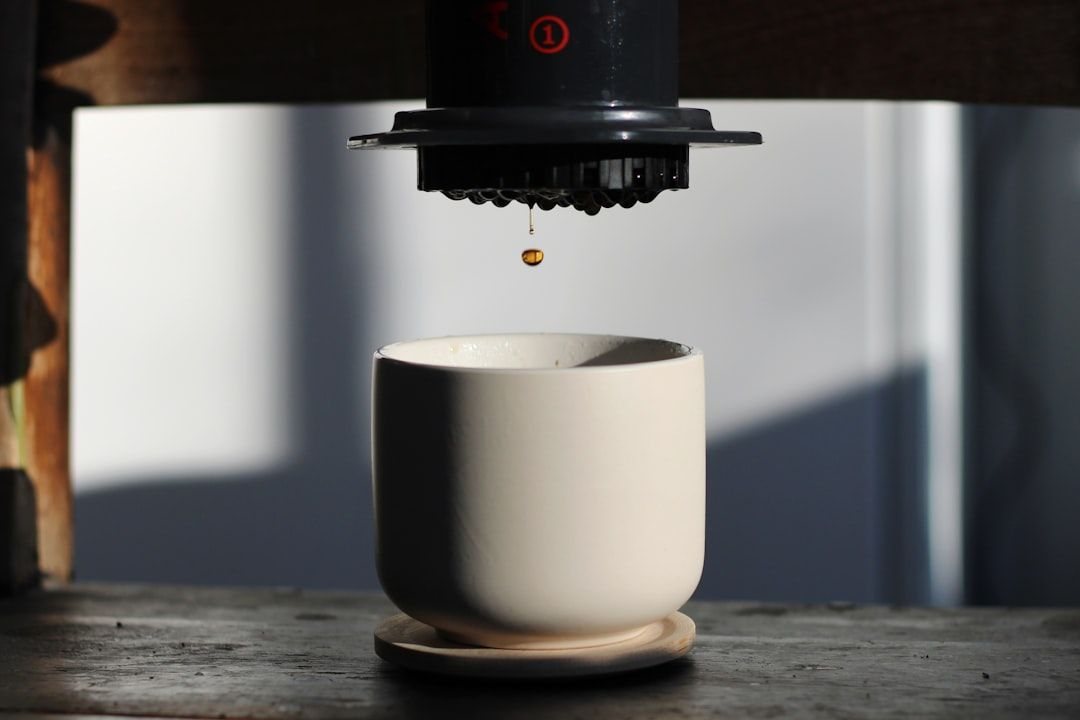
The AeroPress is a manual coffeemaker invented by Alan Adler, a retired Stanford engineering lecturer previously known for patenting the Aerobie flying ring. Adler began prototyping the device in his garage in 2004, motivated by a desire to reduce acidity and bitterness in his daily cup and to gain precise control over brew time, water temperature, and grind size. The device was officially unveiled in November 2005 at the CoffeeFest trade show in Seattle, and in the years that followed it acquired a cult following among coffee enthusiasts drawn to its low cost, flexibility, and brewing consistency.
Structurally, the AeroPress resembles a large syringe. It consists of:
- A translucent cylindrical brewing chamber into which ground coffee and water are loaded
- A plunger fitted with an airtight silicone seal that is pressed down through the chamber to force brewed liquid through the filter
- A screw-on filter cap that holds a small circular paper or mesh filter against the bottom of the chamber
Early models were made from polycarbonate; in 2009 the company switched to BPA-free copolyester, then to polypropylene in 2014, and in 2023 introduced clear Tritan variants. The brewer's functional geometry remained essentially unchanged across all material revisions.
The AeroPress is available in several form factors. The AeroPress Go (released 2019) is a travel-sized model whose accessories nest inside a lidded plastic mug. The AeroPress XL doubles the standard capacity and ships with a 20 oz plastic carafe. Premium and Steel editions feature dual-wall glass and metal chambers, respectively. The AeroPress Original remains the benchmark model for home and competition use.
Brewing Mechanism: Immersion Plus Pressure
The AeroPress occupies a distinctive position among manual brewers because it combines two mechanisms that most other devices employ separately.
Immersion — coffee grounds are fully submerged in water for a defined steeping period, as with a French press. This promotes even, controllable extraction and a forgiving brew window.
Gentle plunger pressure — unlike pure immersion methods, the brewer finishes extraction by physically pressing liquid through the filter. This pressurised final phase can produce a denser, more concentrated cup than drip or pour-over methods, and is capable of yielding an espresso-like concentrate, though the pressure generated by a human plunge is far below the 9 bar used in espresso machines.
Because extraction yield and strength are influenced by grind size, water temperature, steep time, and brew ratio, the AeroPress's adjustability across all these variables gives brewers fine-grained control over the character of the final cup. Water quality and grind uniformity both play important supporting roles.
Filter Options: Paper vs. Metal
The AeroPress ships with 350 circular paper microfilters. Paper filters trap the fine coffee particles and oils that pass freely through coarser metal mesh, producing a cleaner, brighter cup with lower body — a profile that highlights delicate floral and citrus aromatics. This is a meaningful difference: immersion brewers such as the French press are typically used exclusively with metal filters and yield a heavier, oilier body.
For much of the AeroPress's history, the manufacturer recommended paper filters over metal mesh for taste reasons. However, reusable stainless steel mesh filters have long been available from third-party accessory makers, and as of 2024 AeroPress itself sells its own stainless steel mesh filter. Metal filters produce a cup with more body and retain the naturally occurring coffee oils, appealing to drinkers who prefer a fuller mouthfeel. Third-party accessories have expanded the ecosystem further, including pressure-actuated valve caps and cold drip adapters.
Choosing between paper and metal is ultimately a matter of preferred cup character:
| Filter Type | Body | Fines in Cup | Oils Retained |
|---|---|---|---|
| Paper microfilter | Light to medium | Minimal | Low |
| Metal mesh | Medium to full | Some | High |
Standard (Traditional) Brewing Method
In the standard or traditional orientation, the AeroPress sits upright on top of a mug or vessel with the filter cap facing down.
- Insert a paper filter into the cap, rinse with hot water, and screw the cap onto the chamber.
- Set the chamber on a sturdy vessel and add ground coffee — competition-circuit doses commonly fall between 14 and 20 g.
- Pour hot water. The manufacturer's instructions suggest approximately 80 °C (176 °F) for dark roasts and 85 °C (185 °F) for lighter roasts. Competition and specialty-focused recipes commonly use water in the range of 80–92 °C (176–198 °F), reflecting how dramatically temperature shapes extraction and perceived acidity.
- Stir the slurry for approximately 10 seconds.
- Insert the plunger and press steadily. Steeping times in competition recipes typically run 30 to 60 seconds before the plunge begins, with water volumes around 200–230 ml.
The entire process from first pour to finished cup usually takes well under two minutes, making it one of the fastest manual brewing methods.
Inverted Brewing Method
The inverted method was developed by baristas and home brewers seeking more control over steep time and to prevent premature drip-through during the brew.
In this technique:
- The plunger is inserted a short distance into the chamber from the bottom, and the assembly is placed upside-down — resting on the flat top of the plunger.
- Ground coffee is added, followed by hot water, and the slurry is stirred.
- While the coffee steeps, a moistened paper filter is placed in the cap (wetting helps it adhere), and the cap is screwed onto what is now the top of the inverted chamber.
- At the end of the chosen steep time, the brewer is carefully flipped onto a cup and the plunger is pressed.
The primary advantage of the inverted method is that liquid cannot drip through the filter before the brewer is flipped, giving the brewer complete control over contact time. This makes it popular in World AeroPress Championship recipes, where precise, repeatable steep times matter. The trade-off is the flip itself, which requires a steady hand and a stable mug.
Versatility and Forgiveness
The AeroPress is frequently described as the most forgiving manual brewer on the market. Several design properties contribute to this:
- Short brew window: A steep time measured in seconds rather than minutes means a slightly imprecise grind or temperature rarely produces a dramatically poor cup.
- Pressure compensation: The plunge pressure can mask minor extraction inconsistencies that would be more apparent in a slow pour-over.
- Wide acceptable temperature range: Competition-level recipes span 80–92 °C, a range considerably wider than the tight windows demanded by, for example, a Chemex or other drip methods.
- Adjustable dose and ratio: Brewers can dial from a short espresso-style concentrate (to be diluted with hot water or poured over ice) to a full filter-strength serving by changing the dose, water volume, and grind without purchasing additional equipment.
This flexibility has made the AeroPress popular not only with enthusiasts but with travellers, hikers, and anyone seeking a capable brewer that tolerates imperfect conditions.
World AeroPress Championship
The World AeroPress Championship (WAC) is an international, fan-led brewing competition organised independently of the AeroPress manufacturer. It is structured as a multi-round elimination tournament in which competitors have five minutes to brew and present a cup of coffee.
The WAC was first held in Oslo, Norway in 2008 with only three competitors. It grew consistently year over year; the 2018 competition attracted 3,157 competitors from 61 countries. The 2020 championship was cancelled due to the COVID-19 pandemic. Competition resumed in 2021, adopting both in-person events and a new remote/online format allowing competitors to submit recipes and brewed samples without travelling.
The championship has had an outsized influence on AeroPress culture. Winning recipes are publicly shared, driving ongoing experimentation with unusual parameters — very low brew temperatures, extended steeps, non-standard ratios — and expanding the perceived limits of what the brewer can achieve. The WAC is widely credited with sustaining and amplifying the AeroPress's reputation within the specialty coffee community long after its initial release.
Typical Recipes and Starting Parameters
Because the WAC publishes winning recipes and the brewer tolerates wide variation, there is no single canonical AeroPress recipe. The following ranges are drawn from competition practice and the manufacturer's guidelines:
Standard filter-strength recipe:
- Dose: 15–17 g of coffee, ground slightly finer than typical filter grind
- Water: 200–230 ml at 85–92 °C
- Steep: 30–60 seconds with gentle stirring
- Plunge: slow and steady over approximately 20–30 seconds
Concentrate / espresso-style recipe:
- Dose: 18–20 g, finely ground
- Water: 80–100 ml at 80–85 °C
- Steep: 30–45 seconds
- Output: dilute to taste with hot water (for an Americano-style) or pour over ice
General guidance:
- Use a brew ratio broadly in the 12–17:1 water-to-coffee range for concentrate styles; 15–17:1 for filter-strength
- Grind uniformity matters — a quality burr grinder produces more predictable extraction than a blade grinder
- Rinsing the paper filter before brewing reduces any papery flavour notes in the cup
- The inverted method suits recipes with longer steeps; the standard method works well for shorter, more active brews
Dial it in
Live recipe for this method — tweak the dose and ratio, then brew along with the timer. Open the full calculator.
18g coffee · 288ml water (1:16)
Pour schedule
- 0:00Add 18g coffee, pour ~58g, stir to bloom
- 0:30Top up to 288g
- 1:30Insert plunger, press slowly (~30s)
- 2:30Serve immediately
Watch a brew guide
James Hoffmann covers the AeroPress in a 12-minute video. Watch the review below, then see the details and where to buy — all without leaving the page.
James Hoffmann takes a hands-on look at the AeroPress Original. We link it for its specs walkthrough and real-world impressions — form your own view by watching.
More videos
Gear for this
Frequently asked questions
- What makes the AeroPress different from a French press?
- Both are immersion brewers, but the AeroPress adds a plunger pressure phase that forces brewed liquid through a microfilter. The AeroPress paper filter removes fine particles and oils, producing a cleaner, brighter cup with less sediment than a typical French press, which relies on a coarser metal mesh filter and results in more body and oils in the finished cup.
- Is AeroPress coffee similar to espresso?
- The AeroPress can produce a concentrated brew comparable in strength and body to espresso, and it is sometimes used this way as a base for milk-based drinks. However, the pressure generated by pressing the plunger by hand is far below the 9 bar used by espresso machines, so the resulting crema and extraction dynamics differ. The AeroPress is better understood as a highly versatile manual brewer that can be tuned toward either espresso-style concentrate or full filter-strength coffee.
- What is the best water temperature for AeroPress brewing?
- The manufacturer suggests approximately 80 °C (176 °F) for dark roasts and 85 °C (185 °F) for lighter roasts. Competition recipes use a broader range of roughly 80–92 °C (176–198 °F). Lower temperatures tend to reduce perceived acidity and bitterness, which was part of inventor Alan Adler's original design intent.
- What is the inverted AeroPress method and why use it?
- In the inverted method, the AeroPress is assembled upside-down so that no liquid can drip through the filter before brewing is complete. The coffee and water steep freely, and the brewer is then flipped onto a cup before the plunger is pressed. This technique gives the brewer full control over steep time and is popular in competition recipes where precise, repeatable contact times are important.
- What is the World AeroPress Championship?
- The World AeroPress Championship (WAC) is an international, fan-led brewing competition first held in Oslo, Norway in 2008 with three competitors. It grew to attract over 3,000 competitors from more than 60 countries by 2018. Structured as an elimination tournament, competitors have five minutes to brew a cup of coffee. The championship has been influential in driving AeroPress recipe innovation within the specialty coffee community.
- Can I use a metal filter with an AeroPress?
- Yes. While the AeroPress ships with 350 paper microfilters and the manufacturer historically recommended them for taste, reusable stainless steel mesh filters have long been available from third-party makers. AeroPress itself has offered its own metal filter since 2024. Metal filters produce a heavier-bodied cup with more coffee oils retained, similar in character to French press coffee.
See also