Knowledge · brewing
Siphon (Vacuum) Brewing
How vapor pressure, vacuum mechanics, and full immersion combine to produce one of coffee's most theatrical and clarifying brew methods.
Key facts
- Invented
- 1827 by Johann Nörrenberg
- Refined by
- James Robert Napier in 1840
- Also called
- Balance siphon or Belgian brewer
- Brewing method
- Full immersion with vacuum filtration
- Popular in
- Japan and Taiwan
- Grind size
- Medium to medium-fine
- Brew ratio
- 15–18:1 water to coffee
History and Origins
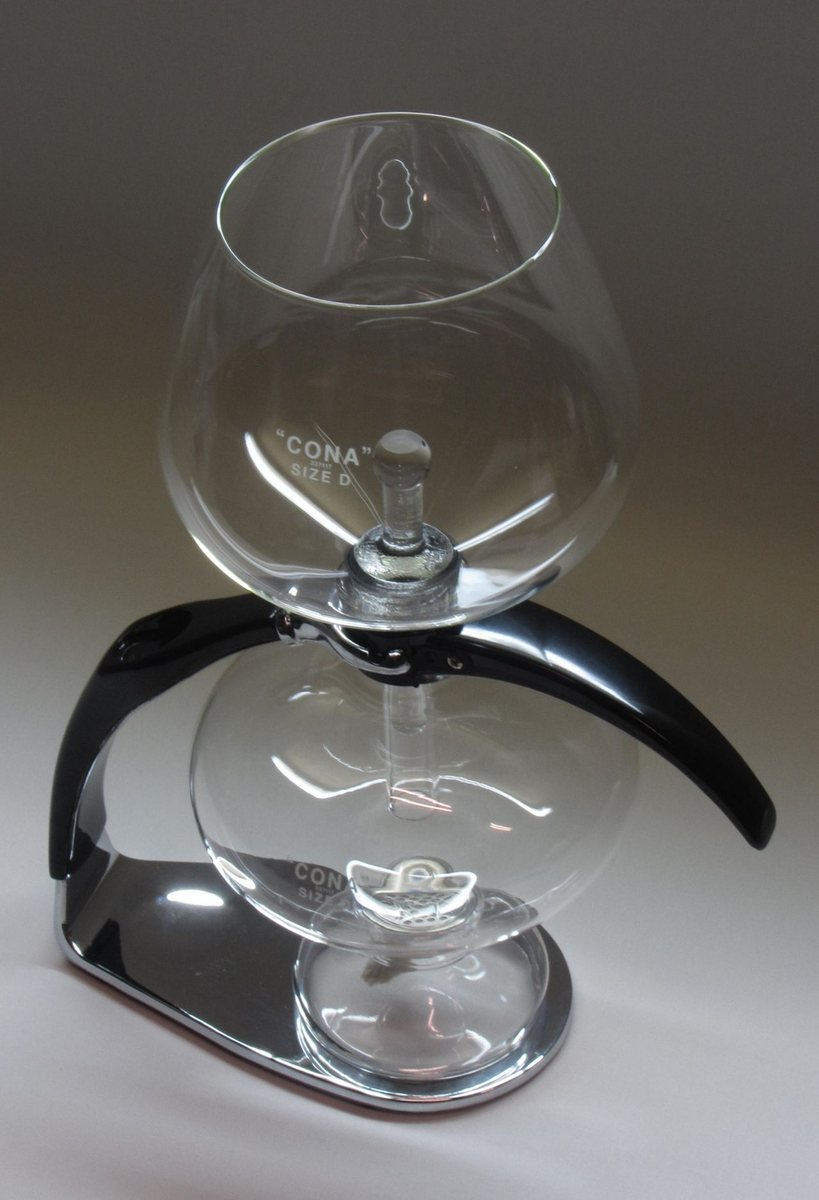
The vacuum coffee maker is among the oldest purpose-built coffee brewing devices still in active use. According to historical record, Johann Nörrenberg invented the two-chamber vacuum brewer in 1827, and the principle was refined publicly when James Robert Napier presented his Napier Vacuum Machine in 1840. An early variation—the balance siphon, also called the Belgian brewer—arranged the two chambers side by side on a balance-like apparatus: once vapor pressure had pushed the water upward, a counterweight activated a spring-loaded snuffer that smothered the flame and initiated the cooling cycle.
The device attracted designers as well as engineers. The Sintrax coffee maker, created by Gerhard Marcks in 1925, brought a Bauhaus aesthetic sensibility to the siphon form. Through the mid-twentieth century, vacuum brewers were prized for producing a notably clear brew, though their complexity limited everyday adoption. Today, siphon brewers remain popular in parts of Asia—particularly Japan and Taiwan—where the method's theatrical qualities have been elevated into a craft tradition. In 2022, the Japanese Tiger Corporation introduced the Siphonysta, an automated, electrically heated vacuum coffee maker with plastic (resin) chambers, signalling renewed commercial interest in the principle.
Vapor Pressure and Vacuum Mechanics
Understanding the siphon requires a firm grasp of the underlying physics, which the device makes visible in real time.
When the lower vessel is sealed and heated, the vapor pressure of the water—combined with the expanding air inside—rises until it exceeds ambient atmospheric pressure. Because water vapor has a density approximately 1/2000 that of liquid water, even a small volume of boiling water generates a large volume of vapor, rapidly increasing pressure in the lower chamber. Once this pressure differential exceeds atmospheric pressure, the remaining liquid water is pushed up through the siphon tube into the upper vessel. The pressure difference required to sustain the water column in the upper vessel is approximately 1.5 kPa (0.015 atm)—maintained by continuous heating.
The water arrives in the upper chamber at slightly below 100 °C (212 °F)—the minor heat loss through the tube means brewing occurs just under the boiling point, a temperature well suited to extracting complex aromatics. (See Brew Temperature for a broader discussion of how temperature affects extraction.)
When the heat source is removed, the lower vessel cools, pressure drops, and the partial vacuum draws the brewed coffee back down through the filter, leaving the spent grounds cleanly behind in the upper vessel. The siphon mechanism is thus entirely driven by thermal energy and atmospheric pressure—no pumps, pistons, or manual agitation are required for the transfer itself.
Full Immersion and Cup Character
Siphon brewing is a full-immersion method: the coffee grounds steep freely in hot water throughout the brew phase, much as they do in a French press or a Hario Switch. This extended contact between water and grounds favors even extraction and a developed, rounded flavor profile.
Where siphon brewing diverges meaningfully from other immersion methods is in the filtration stage. As the brew is drawn back into the lower vessel, it passes through a filter—commonly made of cloth, metal mesh, paper, or nylon—under the gentle but consistent pull of the vacuum. This combination of full immersion and vacuum-assisted filtration produces a cup that is simultaneously:
- Full-bodied — the immersion phase extracts a broad range of soluble compounds
- Visually clear — the filter removes fine particles and a significant portion of suspended oils
- Aromatically expressive — because brewing occurs in an open upper vessel, volatile aromatics are less trapped than in pressurized methods
Characteristics such as acidity (brightness), floral and citrus notes, and finish length are often described as particularly pronounced in a well-executed siphon brew. The method's ability to render these qualities consistently made it prized for evaluation long before specialty coffee codified sensory language.
Grind, Ratio, and Brew Variables
Because the siphon is an immersion method with a defined steep time, grind size is a critical control lever. The general principle, supported by coffee preparation science, is that longer water-contact methods require a coarser grind to avoid over-extraction: coffee ground too finely will expose excessive surface area, risking a bitter, harsh result, while an overly coarse grind produces weakness unless dose is increased. For the siphon, a medium to medium-fine grind is commonly employed—finer than drip but not as fine as espresso—balanced against a steep time that is typically kept short and precisely timed.
A uniform particle distribution is especially important with the siphon filter, as fines can clog cloth or mesh screens and impede the vacuum draw. A quality burr grinder is strongly recommended; burr mills produce a more consistent particle size than blade grinders by crushing and tearing beans between two abrasive elements with minimal frictional heat. See Grinding & Particle Size for a full treatment of grinder types and their effect on extraction.
Brew ratios for siphon brewing typically fall within the broadly accepted range of 15–18:1 water to coffee by mass cited across brewing standards, though practitioners often favor the stronger end of this range to compensate for the clarity of the cup. See Brew Ratio for guidance on dialing in dose. Water quality also merits attention: because the siphon produces a particularly transparent brew, off-flavors from mineral imbalance or chlorine are more perceptible than in heavier-bodied methods.
Steep time is the remaining primary variable. Once water has fully transferred to the upper vessel, the grounds are stirred to ensure even saturation, and the steep is timed carefully—commonly in the range of one to two minutes, depending on grind and dose—before heat is removed to initiate the draw-down. Precise, repeatable timing is central to the method.
Ritual, Theatre, and the Japanese Kissaten Tradition
No other manual brew method so thoroughly transforms the act of making coffee into a visual performance. The siphon's glassware is inherently dramatic: the upward surge of water, the turbulent bloom of grounds in the upper chamber, the slow pull of amber liquid back through the filter—all are fully visible and follow a logical, unhurried sequence.
In Japan, this quality became the foundation of a distinct café culture. The kissaten (喫茶店)—a traditional Japanese coffee house—elevated the siphon into a craft ritual practiced by highly skilled baristas known for extraordinary precision and unhurried attention. In the kissaten tradition, the brewer typically works over a halogen or butane flame at the bar counter, in full view of seated guests. Every movement—from grinding to stirring to the moment of heat removal—is deliberate and calibrated. The result is as much performance as beverage.
This tradition contributed to the siphon's enduring commercial relevance in Japan and Taiwan long after it had faded from Western café menus. In the contemporary specialty coffee movement, the siphon has experienced renewed interest as a bar method precisely because it communicates craft visibly and invites the guest to witness extraction science in action. Unlike a Chemex, whose elegance is more static, the siphon moves.
The balance siphon format—with its counterweight mechanism that automatically extinguishes the flame—represents a further theatrical refinement: the device essentially brews itself once set in motion, adding a clockwork quality to the spectacle.
Equipment, Filter Types, and Practical Considerations
Siphon brewers are most commonly constructed of borosilicate glass for both chambers, prized for thermal resistance and clarity. Metal and plastic variants exist, with plastic appearing in modern automated versions such as the Siphonysta. The siphon tube connecting the two chambers must form a seal when the upper vessel is seated.
Filter choice materially affects the cup:
- Cloth filters — the traditional choice in Japanese practice; allow a small amount of oil through, adding a subtle richness while still producing clarity; require cleaning and proper storage between uses
- Metal mesh filters — durable and reusable; produce a slightly heavier body than cloth
- Paper filters — provide the cleanest, most oil-free cup; closest to a Chemex-style clarity
- Nylon filters — a durable mid-point between cloth and metal
Heat sources include butane or alcohol burners, halogen lamps (which allow precise, quick control), and electric induction bases. The ability to remove heat rapidly and precisely is important: the timing of heat removal determines when the vacuum draw begins and, by extension, the final extraction level. See Extraction: Yield & Strength for context on how draw-down speed affects the final dissolved solids in the cup.
Clean-up requires careful handling of the upper vessel and filter after each brew. Cloth filters in particular must be rinsed free of oils immediately and stored wet (or in water in the refrigerator) to prevent rancid flavors transferring to subsequent brews.
Summary
The siphon coffee maker is simultaneously a physics demonstration, a precision brewing instrument, and a cultural artifact. Its two-chamber vapor-pressure mechanism—invented in the early nineteenth century and refined through Bauhaus design and Japanese craft tradition—produces a cup that is full in flavor yet visually clear, expressive in aroma, and reproducible when brewed with care. For those willing to engage with its variables—grind uniformity, steep time, filter choice, heat control, and brew ratio—the siphon rewards with a cup that is difficult to replicate by any simpler means.
Dial it in
Live recipe for this method — tweak the dose and ratio, then brew along with the timer. Open the full calculator.
18g coffee · 288ml water (1:16)
Pour schedule
- 0:00Bloom: pour to 45g, swirl, wait
- 0:45Pour to 126g
- 1:20Pour to 207g
- 1:55Pour to 288g
- 2:45Drawdown complete — serve
Gear for this
Frequently asked questions
- What is the difference between a siphon and a vacuum coffee maker?
- They are the same thing. The device operates on siphon principles—using vapor pressure to push water upward and a vacuum created by cooling to draw brewed coffee back down—so the terms 'siphon,' 'syphon,' and 'vacuum coffee maker' (or 'vac pot') are used interchangeably.
- Why does siphon coffee taste so clean compared to French press?
- Both are full-immersion methods, but the siphon draws the finished brew through a filter under vacuum pressure, removing fine particles and a significant portion of suspended oils. The result is visually clearer and has less sediment than unfiltered immersion methods like French press.
- What grind size should I use for siphon brewing?
- A medium to medium-fine grind is most commonly used. Because the siphon is an immersion method, too fine a grind risks over-extraction and can clog the filter, slowing the vacuum draw. A quality burr grinder producing a uniform particle size is strongly recommended.
- What brew ratio works best for siphon coffee?
- Brew ratios commonly fall in the broadly accepted range of 15–18:1 water to coffee by mass. Many siphon practitioners lean toward the stronger end of this range, since the clarity of the cup can make a lighter extraction taste thin.
- Is siphon brewing still popular today?
- Yes, particularly in Japan and Taiwan, where the siphon has been central to kissaten (traditional coffee house) culture for decades. In the contemporary specialty coffee movement globally, the method has seen renewed interest as a bar-side performance brew.
- What is a balance siphon?
- A balance siphon (also called a Belgian brewer) arranges the two chambers side by side on a balance-like frame. A counterweight attached to the heated chamber triggers a spring-loaded snuffer once vapor has transferred the water, automatically extinguishing the flame and initiating the cooling and vacuum draw cycle.
See also