From the roaster
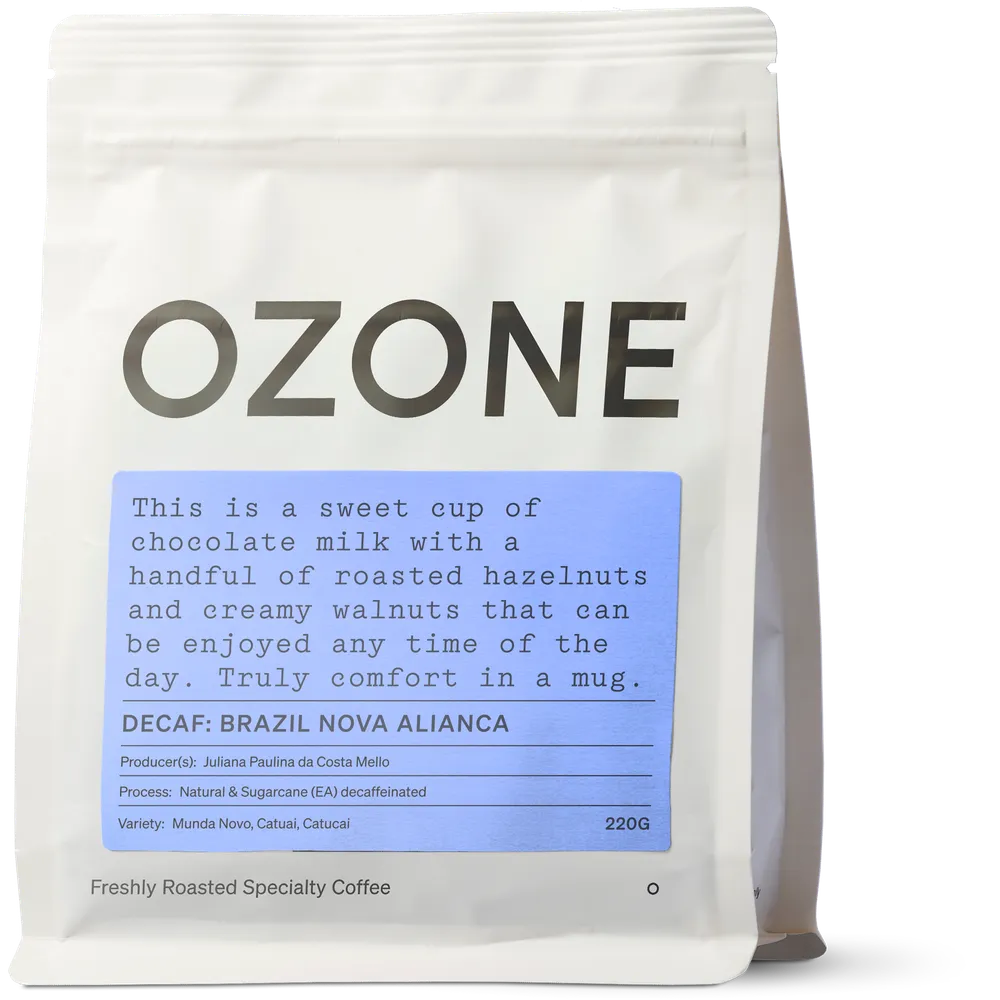
Ozone Decaffeinated Single Origin
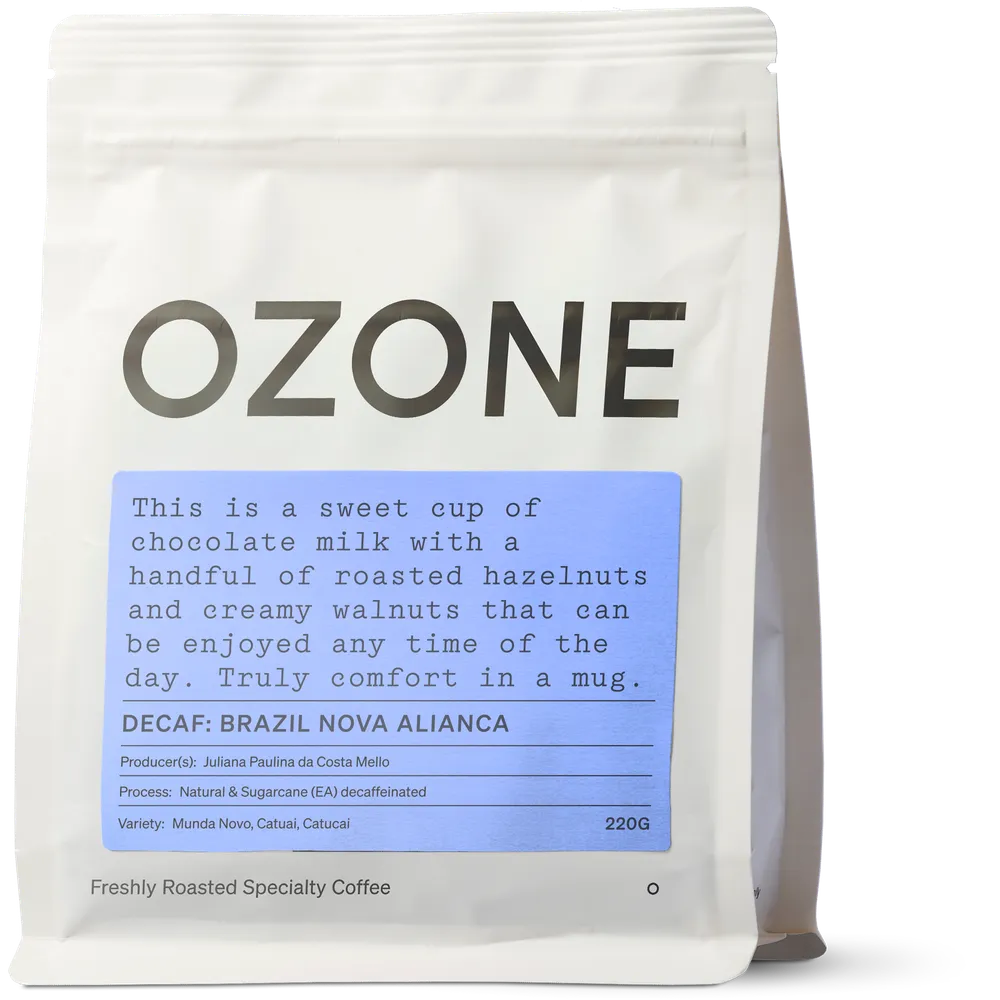
This is a sweet cup of chocolate milk with a handful of roasted hazelnuts and creamy walnuts that can be enjoyed any time of the day. Truly comfort in a mug.
Here at Ozone, we’re always on the lookout for tasty decaf. It can be a little tricky to get hold of, but we aim to have at least one decaf available at all times, and which coffee that is will change throughout the year. If you subscribe to Decaf, you’ll always receive our current fresh decaf, so the farm in your bag will evolve as new coffees come in.
We were one of the first roasters in the UK to move to Colombian decaf, when the ethyl acetate (EA) plant in Colombia started turning out genuinely great coffee. For most of the last ten years our decaf range has been exclusively Colombian, because in blind tastings the EA decafs simply proved more delicious than the CO₂ or Swiss Water options available. The catch? Colombia is a producing country, so decaffeinating anything other than Colombian coffee there was super tricky, and we had to work within those limits.
Ask us for an all-rounder – good any time of day, crowd-pleasing, easy to work with – and nine times out of ten we’ll point you towards Brazil. Bonus points if you remember this one: we once ran a CO₂ decaf of Cachoeira da Grama, and it was really good. We’ve been looking for a way to bring Brazil back into our decaf line-up ever since.
That chance came when we were introduced to EA decaffeination in Bremen, Germany. Finally, we could try what we’d always wanted: EA decaf on a great Brazilian coffee.
The Decaffeination Process
EA decaf uses ethyl acetate, a compound found naturally in fruit like bananas and apples, and in sugarcane, which is where the “sugarcane decaf” name comes from. In Bremen, the green beans are first steamed to open them up, then washed with a solution of water and EA, which bonds with the caffeine and draws it out. More steam removes any remaining EA, and the beans are dried back to their original moisture. What’s left keeps its sweetness, body and origin character. All the flavour, none of the buzz.
Why EA decaf? Here’s the thing: every decaf method is a balancing act between taking the caffeine out and leaving everything else in. EA is highly selective, so it goes after the caffeine and leaves more of the good stuff behind. In our blind tastings it’s consistently held on to more sweetness and origin character than CO₂ or Swiss Water decafs – which is why it’s been our go-to for the best part of a decade.
From a food miles point of view, the extra step adds very little. The coffee travelled from Brazil straight to Germany, part of it was decaffeinated there, and then it all came on to us in the UK together.
Coffee Information - Brazil: Fazenda Cruz Alta
Juliana Paulino da Costa Mello is the 5th generation of her family to be involved in coffee production and together with her husband, agronomist Flavio, owns 150 hectares of land in the region. The area used to be one huge farm but was split up, and surrounding farms are all now owned by members of Juliana's family.
Roland, our Green Buyer had the pleasure of visiting them last summer. They witnessed first-hand that with careful organising and an understanding of long-term sustainability, the farm plants native trees and fruit trees to promote biodiversity. This attention to detail carries through in the care of their plants, with careful measuring of many variables to assess plant health used to guide pruning, planting and harvesting.
-
Country: Brazil
-
Region: Sul de Minas
-
Municipality: Monte Santo de Minas
-
Farm: Nova Aliança
-
Producers: Juliana Paulina da Costa Mello
-
Varieties: Mundo Novo, Yellow Catuai, Yellow Catucai
-
Process: Natural
-
Elevation: 1,000 - 1,100 m.a.s.l.
-
Farm Size: 110 hectares
-
Decaffeination: Sugarcane (EA) Decaffeination
Cupping Scores
Tasting notes: Walnut, cocoa nib, hazelnut.
Cup of Excellence Cupping Scores
-
Clean Cup: 6/8
-
Sweetness: 6.5
— Has Bean
Tasting notes
- Walnut
- cocoa nib
- hazelnut
As listed by Has Bean.
Origin & producer
- Country
- Brazil
- Region
- Sul de Minas
- Producer
- Juliana Paulina da Costa Mello
- Altitude
- 1,000–1,100 m
Process & variety
- Process
- Natural
- Variety
- Mundo Novo
Roast & brewing
- Acidity
- not stated
- Bag size
- 265 g