From the roaster
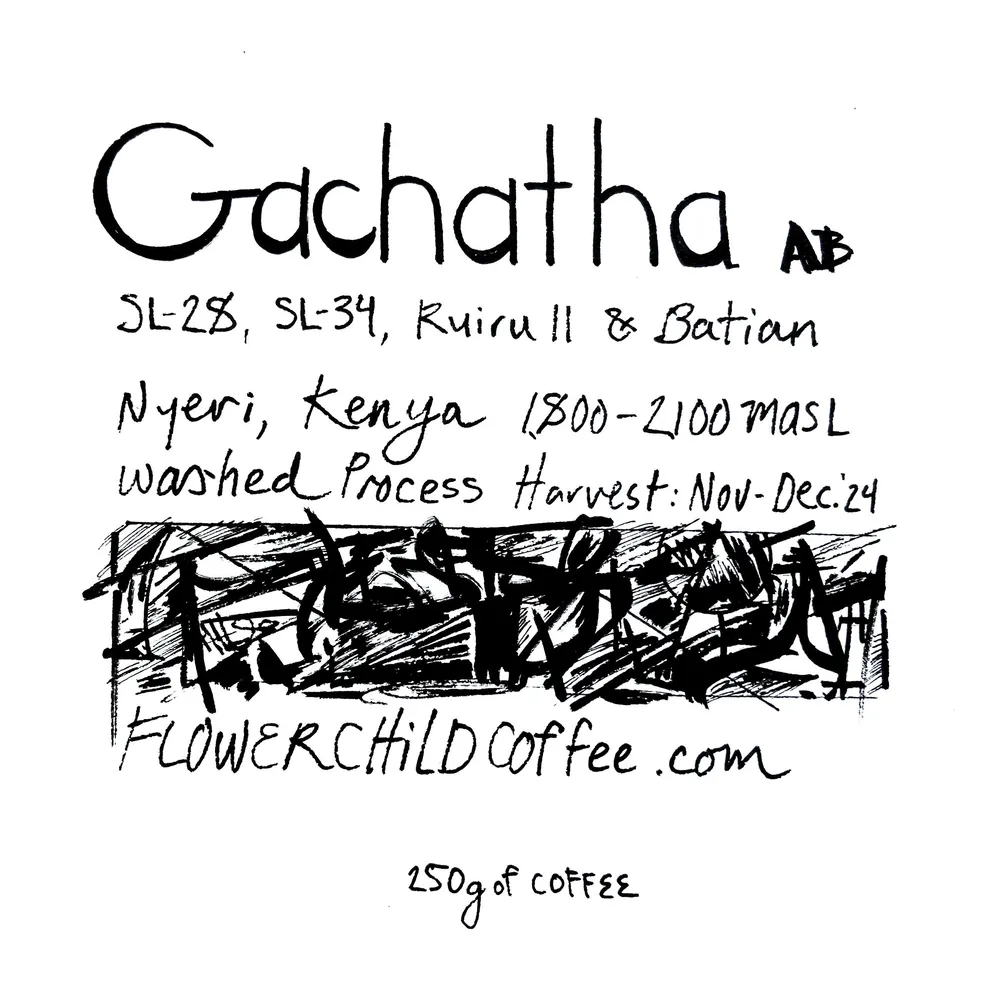
Variety: SL-28, SL-34, Ruiru 11, Batian
Region: Nyeri, Kenya
Altitude: 1800-2100 MASL
Process: Washed
Harvest: Nov-December 2024
Notes: Currant, Sugar Cane & Mandarin.
A coffee like no other has landed from the villages around Nyeri, Kenya. One of our most astounding lots of the year comes from a community of people that have built out an incredible legacy that is now infamously known as Gachatha. In the cup I experience a multitude of notes clearly presented on the palate, here are some highlights: lively, dried berry, mandarin orange, sharp, clean and a cane juice viscosity. This cup is well structured, when warm it is rounded and juicy and as it cools the profile transforms with a bright complexity. Gachatha neatly layers tropical fruits with an acidity that sings soprano.
Gachatha Coffee Factory rests on a 392-acre piece of land between the villages of Muthuaini, Thiriku, Gachenge, and Kianjau. It started in 1963 and its current members stand at 1,542. The factory treats all wastewater in soaking pits to ensure no contaminates run into the local waterways, which are a source for drinking water. The community also places great importance on protecting the indigenous trees that remain in the area, so that the local bird life remains intact.
Although this lot is largely comprised of SL-28, it undoubtedly includes other local varieties such as Batian, SL-34, and Ruiru-11. The region is rich with deep, fertile, well-drained red volcanic soils, ideal for coffee production. After picking, ripe cherry is brought to the factory by smallholder farmers to undergo wet processing. Gachatcha factory uses electrical pumps to move water from the nearest water source to reservoir tanks before using it for processing. Water is recirculated for conservation throughout. The factory uses a disc pulper with three sets of discs to remove the skin and fruit from the inner parchment layer that protect the green coffee bean. After pulping, the coffee is fermented overnight to break down its sugars before it is cleaned, soaked, and spread out on raised drying tables. Time on the drying tables depends on climate, ambient temperature and total production volumes currently undergoing processing. Hulling machinery removes the parchment layer (endocarp) from wet processed coffee. Hulling dry processed coffee refers to removing the entire dried husk—the exocarp, mesocarp and endocarp—of the dried cherries.
Grading and sorting is done by size and weight, and beans are also reviewed for color flaws or other imperfections. Beans are sized by being passed through a series of screens (AB seeds fall through a screen of 15/16 which has a 6.5mm diameter). They are also sorted pneumatically by using an air jet to separate heavy from light beans. Finally, defective beans are removed either by hand or by machinery. Beans that are unsatisfactory due to deficiencies (unacceptable size or color, over-fermented beans, insect-damaged, unhulled) are sorted out. Cooperative members can access pre-financing for school fees, access to farm inputs, and funds for emergency needs from funds set aside from the previous year’s harvest. In line with the rising awareness on the need to conserve the environment, the factory has dug wastewater soak pits away from the water source where the wastewater is allowed to soak in back to the soil.
All of these details from the ripening of the cherry to the curing of the seed help distinguish this lot amongst some of the greatest coffee in the world. I am honored to share the work of the Muthuaini, Thiriku, Gachenge, and Kianjau coffee producers with you. Enjoy!
Our coffees are best after two weeks+ of the roast date.
Last roast was June 30th. A few bags remaining.
— Flower Child Coffee
Tasting notes
- Currant
- Sugar Cane
- Mandarin
As listed by Flower Child Coffee.
Origin & producer
Process & variety
- Process
- Washed
- Harvest
- 2024
Roast & brewing
- Acidity
- not stated
- Bag size
- 265 g